Most of what a tuition centre owns is furniture, whiteboards, aircon and a fit-out. The equipment risk is small. The people risk is not. Children run in corridors, trip on bags, catch fingers in doors and get collected by the wrong adult; parents who would shrug off a bruise at home will not shrug it off at a business they paid. Liability, not property, is where a centre's exposure concentrates.
Layered on top is the commercial reality that most centres sit in a mall, a community hub or a strata unit, and every one of those landlords has an insurance clause. Registration and licensing requirements for private education are administered separately by the relevant authority — confirm current requirements with them — but registration is not insurance, and neither one substitutes for the other.
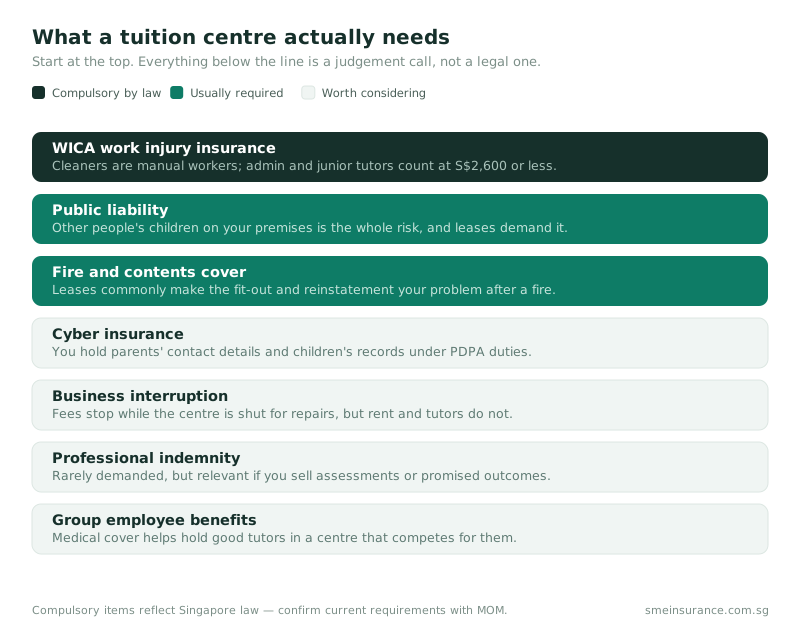
At a glance: what you need, and why
| Cover | Status | Why it matters here |
|---|---|---|
| WICA work injury insurance | Compulsory | Cleaners are manual workers; admin and junior tutors count at S$2,600 or less. |
| Public liability | Usually required | Other people's children on your premises is the whole risk, and leases demand it. |
| Fire and contents cover | Usually required | Leases commonly make the fit-out and reinstatement your problem after a fire. |
| Cyber insurance | Worth considering | You hold parents' contact details and children's records under PDPA duties. |
| Business interruption | Worth considering | Fees stop while the centre is shut for repairs, but rent and tutors do not. |
| Professional indemnity | Worth considering | Rarely demanded, but relevant if you sell assessments or promised outcomes. |
| Group employee benefits | Worth considering | Medical cover helps hold good tutors in a centre that competes for them. |
What the law requires once you hire staff
Two obligations bite as soon as you have employees, and they are separate from each other:
- Work injury compensation (WICA) insurance. Under WICA, insurance is compulsory for every employee doing manual work regardless of what they earn, and for non-manual employees earning S$2,600 a month or less. In a tuition centre that usually means your cleaner, any handyman and your part-time assistants are captured by the manual limb or the salary limb, while a full-time senior tutor on a higher salary may fall outside the compulsory requirement. Failing to insure where the law requires it is an offence carrying a fine of up to S$10,000, up to 12 months' jail, or both. See our WICA guide.
- Foreign Worker Medical Insurance (FWMI). If any staff member holds a Work Permit or S Pass, that person needs mandatory medical insurance with at least a S$60,000 annual claim limit — the enhanced requirement has been fully in effect since 1 July 2025. FWMI sits alongside WICA; it does not replace it.
A practical point on part-timers: centres run on a shifting roster of undergraduate and relief tutors, and the compulsory-insurance test is narrower than the range of people who could be hurt at work. Many centres simply insure the whole payroll rather than re-testing each hire against the threshold every term. Confirm current requirements with MOM.
Nothing in national law makes public liability insurance compulsory for an education business. Your tenancy agreement is a different story.
What your landlord or mall will insist on before you open
Mall operators, community-hub managers and strata landlords almost always require tenants to carry public liability insurance before fit-out begins — commonly S$1 million or more, and frequently with the landlord named as an interested party on the policy. Some also require you to insure your own fit-out and your reinstatement obligation at the end of the lease.
Public liability responds to your legal liability for injury to third parties or damage to their property. In a centre, that is a child who slips on a wet floor, a bookshelf that tips, a scald from a pantry kettle, or water damage you cause to the unit next door. Because your third parties are children and your claimants are their parents, this is the cover most likely to be called on. Our public liability guide explains how limits and excesses work.
Read the insurance clause before you sign. Landlords vary on required limits, on whether they must be named, and on whether they want to see the certificate before handing over keys — and arranging cover mid-fit-out is an avoidable scramble.
Abuse and molestation cover: the extension child-facing businesses should ask about
Any organisation that supervises children — tuition centres, enrichment schools, student care, holiday camps — faces the possibility of an allegation of abuse or improper conduct against a staff member. It is an uncomfortable subject and it is also a straightforward insurance one: abuse and molestation liability is a recognised extension or standalone section that many liability policies offer, and many standard general liability wordings exclude the exposure altogether unless it is added.
What such cover typically addresses is the centre's own liability as the employer — the allegation that the business failed to screen, train or supervise properly — together with defence costs, which are substantial even where an allegation is ultimately not made out. Cover is normally written on a claims-made basis and typically will not respond to the deliberate acts of the individual who committed them.
The insurance is the backstop, not the control. Underwriters will ask what the control looks like: background checks, two-adult rules, classroom sightlines and glass panels, CCTV in common areas, a documented complaints procedure. Having those in place tends to improve both the terms you are offered and the outcome if an allegation ever arrives.
Protecting the premises, the fit-out and the fees you have collected
- Property and contents insurance. Your fit-out, partitions, furniture, aircon, laptops, projectors and teaching materials are usually the largest capital sum in the business. Commercial property cover — fire and extended perils, or all-risks — protects them, and most leases require you to insure the fit-out you installed. See commercial property insurance.
- Business interruption. If a fire, burst pipe or building incident closes the centre for a term, fees stop but rent, tutor retainers and marketing do not — and parents who move their child elsewhere mid-year rarely come back. Business interruption cover, added to the property policy, replaces lost income during the closure.
- Cyber and data. A centre holds names, addresses, school details and parents' contact numbers — personal data of minors, which is exactly the category that draws attention under the PDPA if it leaks. Cyber insurance typically funds breach response, notification and investigation costs.
- Group medical or personal accident benefits if you are competing for good full-time tutors, and money cover if you still take fee payments in cash.
What it roughly costs
Indicative ranges only. Premiums vary with floor area, headcount, student numbers, the age of the children and claims history:
- WICA: from around S$50–100 per employee per year for classroom and administrative roles, more for staff doing manual work.
- Public liability: from around S$100–400 a year per S$1 million of cover. A centre with many young children in a busy mall sits toward the upper end.
- Property and contents: from around S$200–500 a year for a modest fit-out, more where you have invested heavily in build-out or equipment.
- Abuse and molestation extension: priced case by case on your headcount, the ages you teach and your screening and supervision controls. There is no reliable published range — treat it as a specific line item to be quoted.
A single-unit centre with a handful of tutors can often put a sensible programme together for well under S$2,000 a year. A multi-branch operation will pay considerably more. Actual premiums depend on your business — get a quote.
Frequently asked questions
Do I need insurance to run a tuition centre in Singapore?
Yes, if you employ anyone: WICA work injury insurance is compulsory for all employees doing manual work regardless of salary, and for non-manual employees earning S$2,600 a month or less. Beyond that, no national law makes public liability compulsory for education businesses — but your landlord or mall operator will almost certainly require it in the tenancy agreement, and it is the cover a parent's injury claim would fall on.
What happens if a child is injured at my centre?
If the centre is legally liable for the injury, a public liability policy typically responds to the compensation payable to the child's family and to your legal defence costs, up to the policy limit. Liability is not automatic — a parent generally has to show the centre was negligent — but defending the allegation costs money whether or not you were at fault, which is a large part of the reason to hold the cover.
Do part-time and relief tutors need WICA insurance?
It depends on what they earn and what they do: WICA insurance is compulsory for any employee doing manual work regardless of salary, and for non-manual employees earning S$2,600 a month or less — a threshold most part-time and relief tutors fall under. Because rosters change constantly, many centres find it simpler to insure everyone on the payroll than to re-test each person against the threshold. Confirm current requirements with MOM.
Does my policy cover an abuse allegation against one of my tutors?
Only if abuse and molestation liability has been specifically included — many standard liability wordings exclude this exposure entirely. Where it is included, the cover typically addresses the centre's own liability as employer (for example, an allegation of inadequate screening or supervision) and the associated defence costs, rather than the deliberate acts of the individual concerned. Ask about it by name when you request quotes.
My centre is in a mall. What insurance will the landlord ask for?
Most commonly public liability insurance at S$1 million or more, often with the landlord named as an interested party, plus cover for your own fit-out and sometimes for your reinstatement obligation at lease end. Requirements vary by landlord, so read the insurance clause before you sign rather than after the fit-out contractor has started work.
Does insurance cover students' personal data if my system is breached?
Cyber insurance is the cover designed for it — it typically funds breach investigation, notification, legal advice and the cost of responding to a regulator, rather than the underlying data itself. Centres hold personal data about minors and their parents, which makes a breach a live PDPA issue, so this is worth pricing even for a small operation.
Related cover & guides
Public Liability Insurance
Covers third-party injury and property damage. Not legally compulsory, but contractually required almost everywhere.
Read more →Work Injury Compensation (WICA) Insurance
Compulsory cover for workplace injuries. Required for all manual workers and non-manual staff earning ≤S$2,600/month.
Read more →Commercial Property & Fire Insurance
Protects premises, renovation, stock and equipment against fire and other damage. Often required under your tenancy agreement.
Read more →Is Business Insurance Compulsory in Singapore?
Only three covers are legally compulsory for a typical SME. See exactly which apply to your business, and what contracts add on top.
Read more →