Food businesses concentrate risk in a small space: open flames and hot oil, wet floors, knives, gas lines, a constant flow of customers, and a workforce doing manual work all day. That combination means an F&B operator faces both compulsory insurance obligations and, in practice, contractual ones — most landlords and mall operators won't hand over the keys without proof of public liability cover.
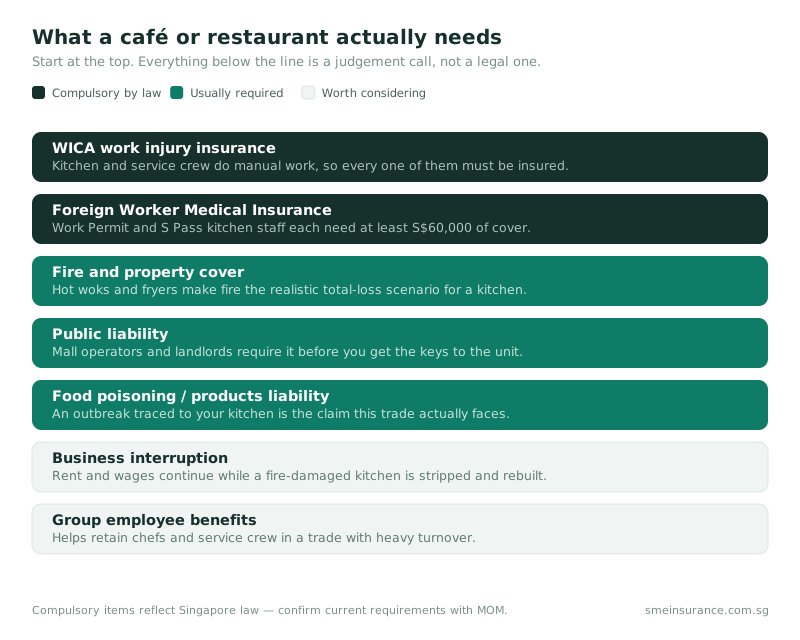
At a glance: what you need, and why
| Cover | Status | Why it matters here |
|---|---|---|
| WICA work injury insurance | Compulsory | Kitchen and service crew do manual work, so every one of them must be insured. |
| Foreign Worker Medical Insurance | Compulsory | Work Permit and S Pass kitchen staff each need at least S$60,000 of cover. |
| Fire and property cover | Usually required | Hot woks and fryers make fire the realistic total-loss scenario for a kitchen. |
| Public liability | Usually required | Mall operators and landlords require it before you get the keys to the unit. |
| Food poisoning / products liability | Usually required | An outbreak traced to your kitchen is the claim this trade actually faces. |
| Business interruption | Worth considering | Rent and wages continue while a fire-damaged kitchen is stripped and rebuilt. |
| Group employee benefits | Worth considering | Helps retain chefs and service crew in a trade with heavy turnover. |
What the law requires before you open
Two obligations apply to almost every F&B business with staff:
- Work injury compensation (WICA) insurance. Kitchen staff, servers, dishwashers, delivery riders you employ directly — these are manual-work roles, so under WICA you must insure them regardless of salary. Non-manual employees (say, an office-based admin) must be insured if they earn S$2,600 a month or less. Going without is an offence carrying a fine of up to S$10,000, up to 12 months' jail, or both. See our full WICA guide.
- Foreign Worker Medical Insurance (FWMI). If you employ Work Permit or S Pass holders — common in kitchens — each one needs mandatory medical insurance with at least a S$60,000 annual claim limit (the enhanced requirement fully in effect since 1 July 2025). FWMI is a separate obligation from WICA; you need both. Confirm current requirements with MOM.
Beyond insurance, you'll deal with SFA licensing and other operational requirements — those are outside the scope of this page, but note that no national law makes public liability insurance compulsory for F&B. Your lease is another matter.
What your landlord or mall will demand
Practically every mall operator and most private landlords in Singapore require tenants to carry public liability insurance — typically with a limit of S$1 million or more, and often naming the landlord as an interested party — before fit-out works begin. Some also require you to insure your own fit-out and reinstatement obligations.
Public liability covers your legal liability for injury to third parties or damage to their property: a customer who slips on a wet floor, a scald from spilled soup, damage to the mall's premises from a kitchen fire spreading. For a business serving the public all day, it's the cover most likely to be called on. Read more in our public liability guide.
Check your lease's insurance clause before you sign — landlords vary on required limits and on whether they need to be named on the policy, and retrofitting cover after fit-out has started is an avoidable scramble.
Fire, equipment and food poisoning: the covers worth adding
- Fire and property / contents insurance. An F&B fit-out — kitchen equipment, exhaust systems, furniture, renovation — is often the largest investment the business has made. Commercial property cover (fire and extended perils, or all-risks) protects it. Kitchens are a genuinely elevated fire risk, and insurers may ask about your hood cleaning and suppression arrangements. See commercial property insurance.
- Food and drink poisoning liability. Many public liability or package policies for F&B can include an extension for illness caused by food or drink you sell. Given that a single contamination incident can affect dozens of customers at once, check whether this extension is included and at what limit — it is not automatic in every policy.
- Business interruption. If a fire or major incident closes your outlet for weeks, rent and salaries don't stop. Business interruption cover, added to a property policy, replaces lost gross profit during the closure.
- Money and burglary cover for cash-heavy operations, and group medical or personal accident benefits if you're competing for staff.
What it roughly costs
Indicative ranges only — F&B premiums vary widely with floor area, cooking style (open flame vs reheating), and claims history:
- WICA: roughly S$100–300 per employee per year for light manual roles like service and kitchen work; office staff from around S$50–100.
- Public liability: from around S$100–400 a year per S$1 million of cover, though busy, high-footfall premises sit toward or above the top of that range.
- Property/contents: from around S$200–500 a year for a modest fit-out; substantially more for large kitchens with high-value equipment.
A small café might assemble a compliant, sensible programme for well under S$2,000 a year; a full-service restaurant with a big team will pay more. Actual premiums depend on your business — get a quote.
Frequently asked questions
Do I need insurance to open a café in Singapore?
Yes — if you employ anyone, WICA work injury insurance is compulsory for all manual-work staff (kitchen and service roles) and for non-manual staff earning S$2,600 a month or less, and your lease will almost certainly require public liability insurance too. No law makes public liability itself compulsory, but landlords and mall operators treat it as a condition of tenancy in practice.
Is public liability insurance compulsory for restaurants?
Not by statute — but effectively yes for most restaurants, because landlords and mall operators typically require it in the lease, often at S$1 million or more. Even without a lease requirement, a business serving the public daily is exposed to slip, scald and property-damage claims that public liability is designed to cover.
Does insurance cover food poisoning claims?
It can, if your policy includes a food and drink poisoning extension — this is common in F&B public liability and package policies but not automatic. Check the extension exists and the limit is meaningful, because a single contaminated batch can generate claims from many customers at once.
My kitchen staff are on Work Permits — what insurance do they need?
Two separate covers: WICA work injury insurance (compulsory for all manual workers regardless of salary) and Foreign Worker Medical Insurance with at least a S$60,000 annual claim limit, which is mandatory for every Work Permit and S Pass holder. One does not substitute for the other. Confirm current requirements with MOM.
Do hawker stalls and cloud kitchens need the same cover as restaurants?
The legal core is the same — WICA for any staff doing manual work — but the rest scales with your setup. A hawker stall has less fit-out to insure and its premises requirements come from the operator (e.g. NEA-managed centres or private coffeeshop landlords), while a cloud kitchen operator will typically set its own public liability requirements in the licence agreement. Check what your specific landlord or operator requires before you commit.
Related cover & guides
Work Injury Compensation (WICA) Insurance
Compulsory cover for workplace injuries. Required for all manual workers and non-manual staff earning ≤S$2,600/month.
Read more →Public Liability Insurance
Covers third-party injury and property damage. Not legally compulsory, but contractually required almost everywhere.
Read more →Commercial Property & Fire Insurance
Protects premises, renovation, stock and equipment against fire and other damage. Often required under your tenancy agreement.
Read more →Foreign Worker Medical Insurance (FWMI): MOM Requirements
Mandatory medical cover for every Work Permit and S Pass holder — at least S$60,000 annual claim limit, separate from WICA.
Read more →