Business interruption (BI) insurance — sometimes called loss of profits or consequential loss cover — pays for the financial consequences of physical damage to your business: the gross profit you don't earn and the fixed costs that keep accruing while your premises are unusable. It's bought as an extension to a commercial property policy, and for single-location businesses it's frequently the difference between an insured setback and a quiet closure.
What business interruption insurance pays
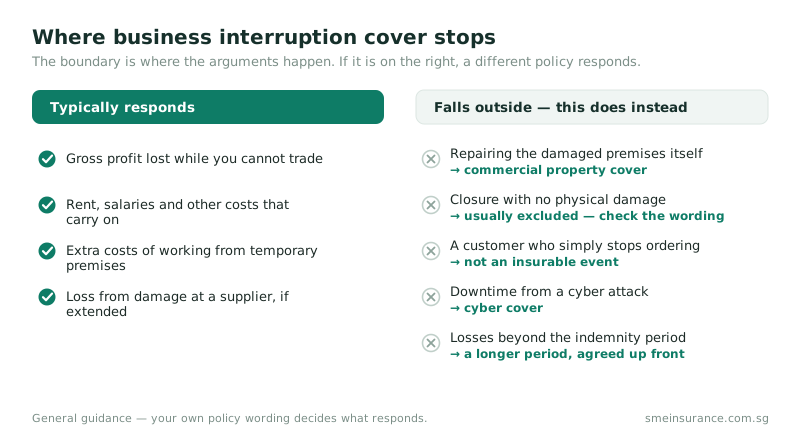
After insured damage shuts or slows your business, a BI policy typically pays:
- Lost gross profit — the revenue you would have earned, less the costs that stop when you're not trading (like cost of goods you're not selling). The policy aims to put you where you'd have been had the damage not happened, based on your trading history and trajectory.
- Continuing fixed costs — rent, salaries you keep paying, loan repayments, utilities minimums: the outgoings that don't pause just because revenue did.
- Increased cost of working — reasonable extra spending to keep trading or come back faster: a temporary premises, overtime, expedited equipment freight. Insurers generally welcome these costs because they shrink the bigger loss.
What it doesn't pay: losses with no insured physical damage behind them, the portion of downtime caused by underinsurance of the property itself, and losses beyond your chosen indemnity period — which brings us to the decision that matters most.
| Item | Covered by BI? | Note |
|---|---|---|
| Lost gross profit | Typically yes | Measured on the policy’s definition of gross profit, which is not your accountant’s |
| Continuing fixed costs — rent, salaries, loan repayments | Typically yes | The outgoings that carry on while trading has stopped |
| Increased cost of working | Typically yes | Reasonable extra spend to keep trading or reopen sooner — temporary premises, overtime, expedited freight |
| Repairing the damaged building, stock or equipment | No | That is the property policy; BI pays the earnings loss that follows the damage |
| Loss with no insured physical damage behind it | Usually not | Standard BI follows insured damage; some exposures can only be picked up by extension |
| Supplier or customer failure | Only if extended | A contingent BI or supplier extension, usually scoped or named — ask for it specifically |
The indemnity period: the most important number in the policy
The indemnity period is the maximum length of time the policy pays from the date of damage — commonly offered at 12, 18 or 24 months. Choosing it is a planning exercise, not a guess. Work backwards through a realistic worst case:
- How long for the insurer's assessment and, if needed, debris removal and permits?
- How long to reinstate the fit-out — including approvals from the landlord or MCST, and contractor lead times?
- How long to replace specialised equipment, some of which may ship from overseas?
- And after reopening: how long until revenue is back to pre-loss levels, not just until the doors open? Customers who found alternatives don't all return on day one.
Add those up honestly and 12 months is often tight for anything beyond minor damage. The indemnity period stops the clock regardless of whether you've actually recovered — a business that reopens in month 10 but rebuilds its revenue by month 20 bears months 13–20 alone on a 12-month policy. Choosing 18 or 24 months typically costs less than the consequences of guessing short.
Setting the sum insured without underinsuring
BI cover is bought on a declared sum insured, usually based on your annual insurable gross profit — and the definition in the policy is an insurance definition, not the gross profit line in your management accounts. Getting it wrong in either direction costs you:
- Too low, and the underinsurance ("average") condition can reduce every claim proportionately — the same trap as property cover, applied to your earnings.
- Forgetting growth. The sum insured must carry you through the indemnity period, which starts at some unknown future date — a growing business should insure forward-looking figures, not last year's. Many policies include trend and growth adjustments; make sure yours reflects your trajectory.
- Mismatched period. An 24-month indemnity period needs a sum insured built on 24 months of gross profit, not 12.
This is one calculation genuinely worth doing with a licensed professional — it takes an hour with your accounts and removes the most common cause of disappointing BI claims. Our guide to business interruption, explained works through a sample calculation.
Extensions worth asking about
Standard BI cover responds to damage at your own premises. Depending on your operations, some exposures sit elsewhere, and extensions exist for them:
- Denial of access — your premises are fine, but damage nearby (or the authorities' response to it) stops customers reaching you.
- Utilities failure — interruption following insured damage at your power, water or telecom provider's facilities.
- Suppliers and customers — damage at a key supplier's or customer's premises that chokes your trading; relevant if one relationship dominates your revenue.
Each extension is typically sub-limited and defined tightly, so read the wording rather than the brochure. Premiums for BI cover overall are quoted on your declared gross profit, indemnity period and trade — actual premiums depend on your business, and quotes vary between insurers, so compare on identical assumptions.
Frequently asked questions
What does business interruption insurance cover?
Business interruption insurance replaces the gross profit you lose and the fixed costs that continue — rent, retained salaries, loan payments — while your business is closed or slowed by physical damage covered under your property policy, plus reasonable extra costs to keep trading. It pays from the date of damage up to the end of your chosen indemnity period, and it aims to put the business where it would have been without the loss.
Can I buy business interruption insurance on its own?
No — BI is sold as an extension to a commercial property (fire or all-risks) policy, and it only pays when the interruption stems from physical damage that the underlying property policy covers. That linkage cuts both ways: an uninsured cause of damage means no BI claim, and underinsured property that slows reinstatement can also depress the BI recovery. Buy and size the two covers together.
What is an indemnity period in business interruption insurance?
The indemnity period is the maximum time the policy pays for lost profit and continuing costs, measured from the date of damage — commonly 12, 18 or 24 months. It should cover not just repairs and reopening but the further months until revenue recovers to pre-loss levels, because the clock stops at the period's end whether or not you've recovered. For anything beyond minor damage, 12 months is often optimistic once landlord approvals, equipment lead times and customer win-back are counted honestly.
Does business interruption insurance cover pandemics or closures without damage?
Standard BI cover does not — it requires physical damage to insured property as the trigger, so closures from disease outbreaks, supplier failures or access restrictions without damage fall outside the core cover. Specific extensions exist for some non-damage scenarios, such as denial of access following damage nearby or utility failures, but each is tightly defined and sub-limited. Read the extension wordings rather than assuming.
How much business interruption cover do I need?
Enough insurable gross profit — as the policy defines it — to carry your business through your full indemnity period, at the trading levels you expect then, not last year's. Underdeclaring triggers proportionate reductions on claims, and a growing firm insuring historical figures is underdeclaring by default. It's a one-hour calculation with your accounts and a licensed professional, and it determines whether the policy performs when it matters.
Related cover & guides
Business Interruption Insurance, Explained
How BI sits on top of property cover: gross profit, increased cost of working, indemnity periods — with a worked F&B fire scenario.
Read more →Commercial Property & Fire Insurance
Protects premises, renovation, stock and equipment against fire and other damage. Often required under your tenancy agreement.
Read more →Fire Insurance vs Property All-Risks: What's the Difference?
Named perils vs all-risks cover explained, what landlords and MCSTs require, and how the average clause punishes underinsurance.
Read more →Insurance for F&B Businesses
Compulsory WICA for kitchen staff, landlord-required public liability, fire and food poisoning cover — what F&B actually needs.
Read more →