
A construction company's risk profile is unusual in two ways. First, its workforce is almost entirely manual and works at height, with machinery, in trenches — so the compulsory work injury regime bites hardest here, and premiums reflect it. Second, much of its insurance is project-driven: main contractors, developers and government tenders dictate what cover must exist before anyone sets foot on site, often in more detail than the law does.
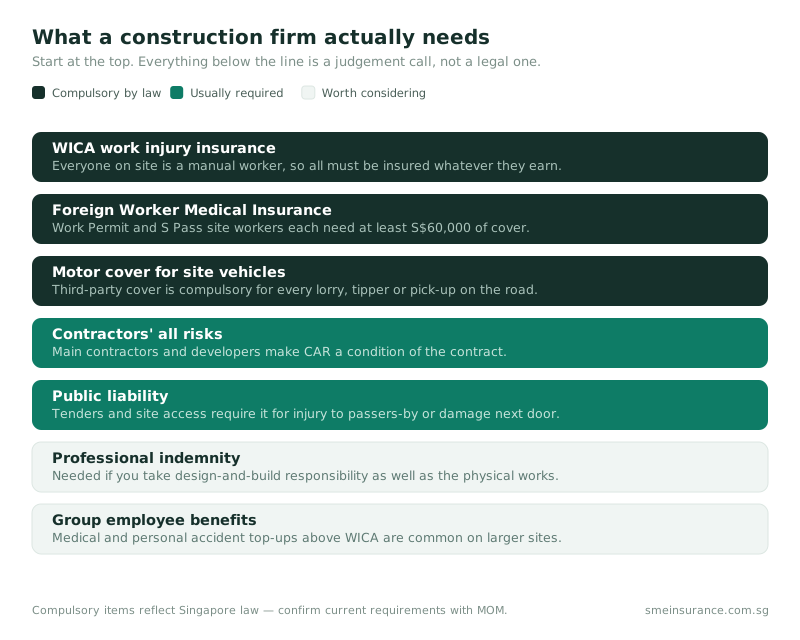
At a glance: what you need, and why
| Cover | Status | Why it matters here |
|---|---|---|
| WICA work injury insurance | Compulsory | Everyone on site is a manual worker, so all must be insured whatever they earn. |
| Foreign Worker Medical Insurance | Compulsory | Work Permit and S Pass site workers each need at least S$60,000 of cover. |
| Motor cover for site vehicles | Compulsory | Third-party cover is compulsory for every lorry, tipper or pick-up on the road. |
| Contractors' all risks | Usually required | Main contractors and developers make CAR a condition of the contract. |
| Public liability | Usually required | Tenders and site access require it for injury to passers-by or damage next door. |
| Professional indemnity | Worth considering | Needed if you take design-and-build responsibility as well as the physical works. |
| Group employee benefits | Worth considering | Medical and personal accident top-ups above WICA are common on larger sites. |
The compulsory layer: WICA and your foreign workforce
WICA insurance is non-negotiable. Construction workers do manual work, so under the Work Injury Compensation Act you must insure every one of them regardless of salary — and non-manual staff earning S$2,600 a month or less as well. Failing to do so is an offence with a fine of up to S$10,000, up to 12 months' jail, or both. Because construction is classified as high-risk work, premiums run to several hundred dollars per worker per year, quoted on your actual trade and work scope. Declare occupations accurately: misclassifying site workers to cut premium is the fastest way to a voided claim. Full details in our WICA guide.
Foreign Worker Medical Insurance (FWMI) is a separate, additional obligation: every Work Permit and S Pass holder must have medical insurance with at least a S$60,000 annual claim limit, a requirement fully in effect since 1 July 2025. Employers of Work Permit holders also deal with security bond obligations for certain nationalities — the bond amounts and mechanics are set by MOM and are often arranged through insurers as a bond guarantee rather than cash; confirm the current requirements for your workers' nationalities with MOM. See our foreign worker insurance guide.
What every project contract will demand
Before work starts, the main contract or subcontract will almost always require:
- Contractors' all risks (CAR). The core project policy. Section 1 covers physical loss or damage to the works themselves — the half-built structure, materials on site, temporary works. Section 2 covers third-party liability arising from the works. CAR is typically bought per project (annual open-cover arrangements exist for firms with steady pipelines), and the contract will specify the required sum insured and liability limit. Government tenders and developer contracts are prescriptive about this. See contractors' all risks.
- Public liability at a specified limit — sometimes inside the CAR policy's Section 2, sometimes standalone — covering injury or property damage to third parties: a passer-by struck by debris, damage to neighbouring property from vibration or excavation.
- Workmen's compensation evidence. Main contractors routinely demand proof of your WICA policy before you mobilise, and may require you to extend cover to their interests.
Read the insurance clause of every contract before pricing the job — required limits vary, and the premium for a S$5 million liability limit is materially different from S$1 million.
Machinery, vehicles and the subcontractor chain
- Commercial motor insurance is compulsory for every vehicle you put on the road — lorries, tippers, vans — under the Motor Vehicles (Third-Party Risks and Compensation) Act. Site-only plant may fall outside motor requirements but still needs cover. See commercial motor and fleet.
- Machinery and equipment cover. Excavators, cranes, generators and power tools are expensive, mobile and theft-prone. Contractors' plant and machinery cover protects owned equipment; check whether hired-in plant is your responsibility under the hire agreement — it usually is.
- The subcontractor chain. As a main contractor, your CAR policy can often be arranged to cover subcontractors' work on the project, but their workers remain their WICA obligation. Collect and verify subcontractors' WICA and liability certificates before they start — an uninsured subcontractor's accident has a way of climbing the chain to whoever has insurance and assets.
What construction insurance roughly costs
Construction premiums are the least standardised of any industry — they're rated on contract value, trade, height, and claims record. Indicatively:
- WICA: several hundred dollars per site worker per year, quoted on actual work scope; office staff from around S$50–100.
- CAR: typically quoted as a percentage of contract value, varying with the nature of the works — a small residential job costs far less to insure than piling next to an MRT line. There's no honest flat figure; get project-specific quotes.
- Public liability: from around S$100–400 a year per S$1 million of cover for low-risk operations, but construction work is rated well above office-based businesses.
- Commercial motor: roughly S$1,000–2,500 per vehicle per year, more for heavy or specialist vehicles.
Actual premiums depend on your business and each project — treat these as orientation, and get quotes.
Frequently asked questions
What insurance is compulsory for a construction company in Singapore?
WICA work injury insurance for all manual workers regardless of salary (and non-manual staff earning S$2,600/month or less), FWMI medical insurance for every Work Permit and S Pass holder, and third-party motor insurance for every road vehicle. Contractors' all risks and public liability aren't compulsory by statute, but virtually every construction contract requires them before work starts.
Is contractors' all risks insurance required by law?
No — CAR is a contractual requirement, not a statutory one. In practice that distinction rarely matters: main contracts, developer agreements and government tenders almost always mandate CAR at specified limits, and for renovation works MCSTs and building managers commonly require it too. You won't get on site without it.
How much does WICA insurance cost for construction workers?
Indicatively several hundred dollars per worker per year — construction is rated as high-risk manual work, so premiums sit well above office or retail rates and are quoted on your actual trade, work scope and claims history. Get a quote based on your real workforce classification; understating it can void claims.
Do my subcontractors' workers need to be on my WICA policy?
No — each subcontractor is the employer of its own workers and carries its own WICA obligation. But you should verify their certificates before they mobilise, because an uninsured accident on your site creates pressure up the chain. Your CAR policy can often be extended to cover subcontractors' works, which is a separate question from their workforce cover.
What insurance do I need for foreign construction workers?
At minimum: WICA insurance (they do manual work, so it's compulsory at any salary) plus Foreign Worker Medical Insurance with at least a S$60,000 annual claim limit for every Work Permit and S Pass holder. Employers of Work Permit holders may also have security bond obligations depending on nationality, commonly arranged through an insurer's bond guarantee — confirm the current requirements with MOM.
Related cover & guides
Work Injury Compensation (WICA) Insurance
Compulsory cover for workplace injuries. Required for all manual workers and non-manual staff earning ≤S$2,600/month.
Read more →Contractors' All Risks (CAR) Insurance
Covers construction and renovation works, materials and third-party damage. Routinely required by landlords, MCSTs and main contractors.
Read more →Public Liability Insurance
Covers third-party injury and property damage. Not legally compulsory, but contractually required almost everywhere.
Read more →Foreign Worker Medical Insurance (FWMI): MOM Requirements
Mandatory medical cover for every Work Permit and S Pass holder — at least S$60,000 annual claim limit, separate from WICA.
Read more →