
The Work Injury Compensation Act (WICA) lets employees claim compensation for work-related injuries or diseases without suing their employer. To make sure that compensation is actually there when it's needed, the law requires employers to carry work injury compensation insurance for large parts of their workforce — and backs it with criminal penalties.
Who you must insure
Under WICA, an employer must buy work injury compensation insurance for:
- All employees doing manual work — regardless of how much they earn. This covers kitchen staff, warehouse and logistics workers, cleaners, technicians, drivers, construction workers and similar roles.
- All non-manual employees earning S$2,600 a month or less in basic salary.
For non-manual employees earning above S$2,600, insurance is optional — but if they are injured at work they can still claim WICA compensation from you, and without a policy the payout comes out of your company's pocket. Many employers insure the whole team for this reason; the marginal premium is usually small.
WICA itself covers any employee under a contract of service, local or foreign, full-time or part-time, regardless of salary. It does not cover independent contractors, domestic workers, or uniformed personnel. Since 1 January 2025, platform workers such as delivery riders and private-hire drivers also receive WICA-equivalent protection through the platform operators they work with.
What the policy pays (limits from 1 Nov 2025)
WICA compensation limits were raised for accidents occurring on or after 1 November 2025:
| Compensation type | Minimum | Maximum |
|---|---|---|
| Death | S$91,000 | S$269,000 |
| Total permanent incapacity | S$116,000 | S$346,000 |
| Medical expenses | Up to S$53,000, or expenses incurred within 1 year of the accident, whichever is reached first | |
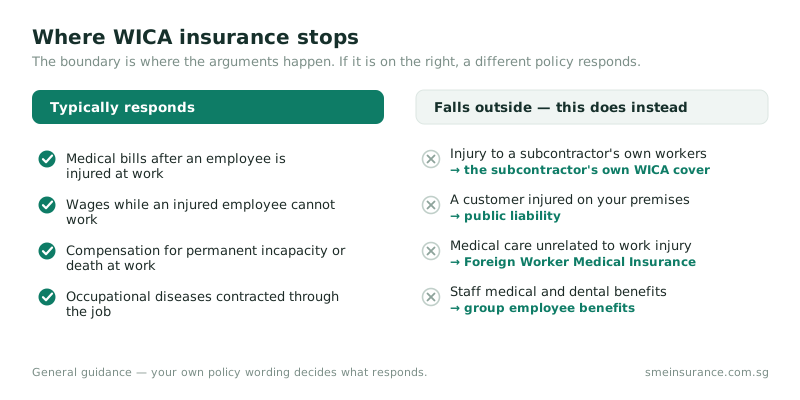
The policy also covers medical leave wages — full average monthly earnings for the first 14 days of outpatient leave (60 days if hospitalised), then two-thirds of earnings up to one year from the accident.
Penalties for going without
Failing to insure an employee you're required to insure is an offence: a fine of up to S$10,000, imprisonment of up to 12 months, or both. Separately, if an uninsured employee is injured, you remain personally liable for the full compensation — a serious injury claim can run into six figures against limits shown above. For an SME, one uninsured accident can be an existential event.
What WICA insurance costs
Premiums are set per employee and depend mainly on occupation risk and payroll. As a rough, indicative guide only:
- Office / non-manual staff: from around S$50–100 per employee per year
- Light manual work (retail, F&B service, warehousing): roughly S$100–300 per employee per year
- Higher-risk manual work (construction, marine, heavy machinery): several hundred dollars per worker per year, quoted on your actual work scope
Actual premiums vary by insurer, claims history, and how your workforce is classified — and industry commentators expect adjustments following the November 2025 limit increases. Treat the ranges above as a sense-check, not a quote.
Buying it right: three things to check
- Declare occupations accurately. Misclassifying manual workers as office staff to save premium can void a claim — the most expensive shortcut in this market.
- Use a MOM-recognised insurer. WICA policies must be issued by designated insurers in Singapore; a licensed professional will only quote you compliant policies.
- Don't substitute other cover. Group personal accident or medical policies do not satisfy the WICA requirement, however generous they look.
Frequently asked questions
Is WICA insurance compulsory in Singapore?
Yes, for most employers. You must insure all employees doing manual work regardless of salary, and all non-manual employees earning S$2,600 a month or less. Not doing so is an offence carrying a fine of up to S$10,000, up to 12 months' jail, or both.
Do I need WICA insurance for part-time or foreign employees?
Yes. WICA applies to any employee under a contract of service regardless of citizenship or working hours. If a part-timer or foreign employee does manual work, or earns S$2,600 a month or less, you must insure them. Note that foreign Work Permit and S Pass holders separately need mandatory medical insurance (FWMI) — that's a different, additional requirement.
What does WICA insurance not cover?
Injuries that are self-inflicted, sustained under the influence of alcohol or non-prescribed drugs, or from deliberate risk-taking outside work duties are excluded. It also doesn't cover independent contractors or claims pursued through the courts instead of WICA — an injured employee chooses one route or the other.
How much does WICA insurance cost per worker?
Indicatively from around S$50–100 a year for office staff, S$100–300 for light manual roles, and several hundred dollars for high-risk trades — but premiums depend on your insurer, industry classification, payroll, and claims history. Get an actual quote before budgeting.
My staff all earn above S$2,600 and sit at desks — can I skip it?
You're not legally required to insure non-manual employees above S$2,600/month. But they can still claim WICA compensation from you if injured at work, and without insurance your company pays the award itself. Most employers cover everyone; the extra premium for low-risk office staff is modest compared to a six-figure uninsured claim.
Related cover & guides
Is Business Insurance Compulsory in Singapore?
Only three covers are legally compulsory for a typical SME. See exactly which apply to your business, and what contracts add on top.
Read more →Foreign Worker Medical Insurance (FWMI): MOM Requirements
Mandatory medical cover for every Work Permit and S Pass holder — at least S$60,000 annual claim limit, separate from WICA.
Read more →Group Employee Benefits Insurance
Group life, medical, accident and outpatient cover for staff. A talent tool — not a substitute for WICA or FWMI obligations.
Read more →Public Liability Insurance
Covers third-party injury and property damage. Not legally compulsory, but contractually required almost everywhere.
Read more →