Group employee benefits insurance is a package of covers an employer buys for the whole team — typically some combination of group term life, group hospital and surgical, group personal accident, and outpatient benefits. Employees get protection they'd struggle to buy as cheaply alone (usually without medical underwriting, up to free cover limits); employers get a concrete answer to the benefits question every serious candidate now asks.
The building blocks of a group benefits programme
Most SME programmes are assembled from four blocks, in roughly this order of adoption:
- Group term life (and often disability riders) — pays a lump sum, commonly set as a multiple of annual salary, if an employee dies, with riders extending to total permanent disability and critical illness. The foundation layer, and usually the cheapest per head.
- Group hospital & surgical (GHS) — covers hospitalisation and surgery costs, structured by ward class. The benefit employees value most, and the one candidates ask about.
- Group personal accident (GPA) — lump-sum payments for accidental death or injury, on or off duty, worldwide. Inexpensive, and note it does not discharge WICA obligations for work injuries.
- Outpatient benefits (GP and specialist) — clinic visits, and optionally dental and health screening. The most-used and most visible benefit day to day, and typically the most expensive block relative to sums involved.
Group policies are typically annually renewable, priced on your team's size, age profile and industry, and — a real advantage over individual policies — cover employees without individual medical underwriting up to free cover limits, so staff with existing conditions can be insured where they might struggle alone.
| Component | What it covers | Voluntary or required |
|---|---|---|
| Group hospital & surgical | Hospitalisation and surgery costs, usually structured by ward class | Voluntary |
| Group outpatient | GP and specialist clinic visits, sometimes with health screening | Voluntary |
| Group personal accident | Lump sums for accidental death or injury, on or off duty | Voluntary — and it does not discharge WICA |
| Group term life | A lump sum on death, commonly a multiple of salary, often with disability or critical illness riders | Voluntary |
| Dental and optical | Routine dental treatment and eyewear, usually capped per year | Voluntary |
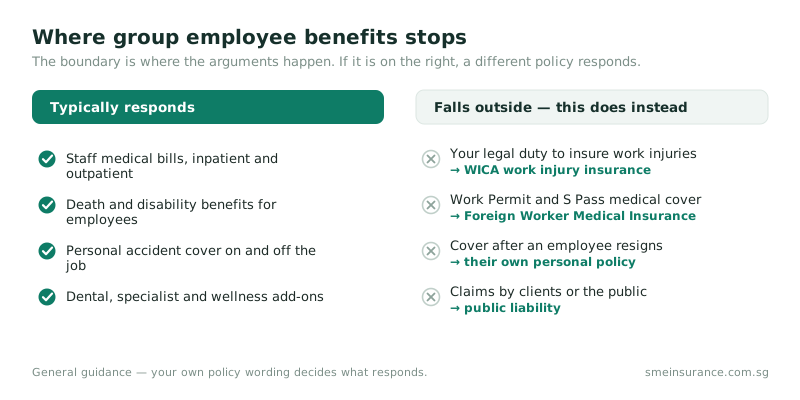
Every component above is a benefit the employer chooses to provide. None of them satisfies a statutory obligation: WICA work injury insurance and Foreign Worker Medical Insurance are separate requirements that have to be arranged separately.
Why SMEs buy it: the talent arithmetic
The business case is straightforward. Larger employers offer benefits as standard, so an SME without them starts every negotiation a step behind — and the gap shows up in hiring, and again every time a competitor's offer lands in a key employee's inbox. Against that, group cover is cheap relative to payroll: a meaningful programme typically costs a low single-digit percentage of an employee's salary.
Beyond recruitment, employers cite three quieter returns:
- Faster treatment, shorter absences. Staff who can afford to see a doctor early tend to be away less.
- Protection against ad-hoc generosity. Without a programme, medical crises get handled case by case out of the company's pocket — unbudgeted and inconsistent. Insurance turns that into a known premium.
- A portable signal of professionalism when pitching for corporate clients or hiring senior people used to being covered.
If you're hiring your first staff and sequencing all this, our guide to insurance when hiring your first employee puts the compulsory and optional covers in order.
What group benefits cost
Indicatively, SME group programmes run from around S$300–800 per employee per year for a basic package, with the final figure driven by:
- Which blocks you include — life and GPA are cheap; GHS ward class and outpatient benefits move the number most.
- Team age profile and industry — older teams and higher-risk trades price higher.
- Benefit levels — ward class, annual limits, panel vs open-choice clinics, co-payments.
- Claims experience — group medical is experience-rated at renewal, so heavy usage feeds into next year's premium.
Actual premiums depend on your team and vary between insurers — get quotes on your actual headcount and census rather than budgeting from ranges. A practical tip: start with a sustainable core (life, GHS, GPA) and add outpatient later; it's far easier to add benefits than to withdraw them.
Group cover, CPF, MediSave and portability
Employees reasonably ask how employer cover interacts with what they already have. The short version: group benefits sit alongside, not instead of, national schemes and personal policies. MediShield Life and any Integrated Shield plans an employee holds continue to operate; group medical typically pays first or coordinates with them, and employees don't draw down MediSave for costs the group policy pays. Our guide on group insurance vs CPF and MediSave untangles the interactions.
One structural point worth raising with a licensed professional: portability. Standard group medical cover ends when employment does — an employee who leaves (or retires) with a medical condition acquired during service may find individual cover hard to obtain. Portable medical benefits arrangements and conversion options, where offered, address this by letting departing employees continue cover individually without fresh underwriting; whether and how to provide them is a design decision when you set the programme up, not something to retrofit later.
Frequently asked questions
What is group employee benefits insurance?
Group employee benefits insurance is a package of covers an employer buys for its whole team — typically group term life, group hospital and surgical, group personal accident, and optionally outpatient GP, specialist and dental benefits. Employees are covered without individual medical underwriting up to free cover limits, which makes it cheaper and more accessible than equivalent individual policies, and the employer pays a single annually renewable premium.
Does group insurance replace WICA or foreign worker medical insurance?
No — group benefits satisfy neither obligation, however generous the plan. WICA insurance remains compulsory for all manual-work employees and non-manual employees earning S$2,600 a month or less, with non-compliance carrying a fine of up to S$10,000 and/or up to 12 months' jail; FWMI remains mandatory for every Work Permit and S Pass holder, with at least a S$60,000 annual claim limit under the enhanced requirement in effect since 1 July 2025. Buy the compulsory covers first and treat group benefits as an addition.
How much do group employee benefits cost per employee in Singapore?
Indicatively from around S$300–800 per employee per year for a basic SME package, with the price driven by which benefits you include, ward class and limits, your team's age profile and industry, and claims experience at renewal. Outpatient and higher ward classes move the premium most. Actual premiums depend on your team — get quotes on your real employee census before budgeting.
Is there a minimum company size for group insurance?
Group plans are available to small teams — many insurers offer SME packages from just a few employees, with simplified underwriting and packaged benefit tiers. Very small groups have fewer customisation options and may face participation requirements (covering all eligible staff rather than a chosen few), but headcount alone rarely rules an SME out. A licensed professional can tell you what's available at your size.
What happens to an employee's group medical cover when they leave the company?
Standard group cover ends with employment, which can leave a departing employee with a condition acquired during service unable to get fresh individual cover. Portable medical benefits arrangements and conversion options — where offered by the insurer and adopted by the employer — allow continuation of cover without new underwriting. It's worth deciding on portability when designing the programme, and it's a fair question for employees to ask about any plan.
Do employees still need their own insurance if the company provides group benefits?
Usually yes, for anything beyond their employment: group cover ends when they leave, benefit levels are set by the employer rather than their needs, and life cover multiples rarely match personal obligations like mortgages. Group benefits sit alongside MediShield Life, Integrated Shield plans and personal policies rather than replacing them. Employees should treat group cover as a valuable layer, not a complete plan.
Related cover & guides
Group Insurance vs CPF/MediSave: What Employers Must Know
What CPF/MediShield already gives employees, what group cover adds, and which obligations — CPF, WICA, FWMI — are mandatory.
Read more →Hiring Your First Employee: Insurance You Now Need
Your first hire triggers WICA if they do manual work or earn ≤S$2,600/month — and FWMI if foreign. Insure before day one.
Read more →Work Injury Compensation (WICA) Insurance
Compulsory cover for workplace injuries. Required for all manual workers and non-manual staff earning ≤S$2,600/month.
Read more →Foreign Worker Medical Insurance (FWMI): MOM Requirements
Mandatory medical cover for every Work Permit and S Pass holder — at least S$60,000 annual claim limit, separate from WICA.
Read more →