
Public liability insurance covers your legal liability when someone outside your business — a customer, a passer-by, a neighbouring tenant — is injured or has their property damaged because of your operations. A wet floor, a falling signboard, a burst pipe from your unit soaking the shop downstairs: these are public liability claims, and the legal costs alone can be substantial before any award is made.
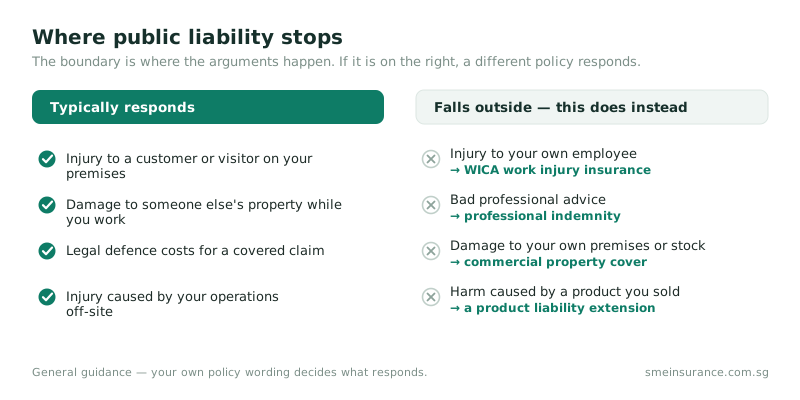
What public liability insurance covers
A public liability policy typically covers your business's legal liability to third parties for:
- Bodily injury — a customer slips on a wet floor in your café, a visitor is struck by falling stock in your warehouse, a pedestrian is hurt by equipment outside your shopfront.
- Property damage — your renovation works crack a neighbouring unit's wall, a water leak from your premises ruins a downstairs tenant's stock, your staff damage a client's property while working on site.
- Legal defence costs — lawyers' fees and court costs in defending a covered claim, usually payable in addition to or within the limit depending on the policy.
What it does not cover matters just as much: injuries to your own employees (that's work injury compensation territory), poor-quality work or advice (that's professional indemnity), and damage to your own property (that's commercial property insurance). Deliberate acts and liability you assume purely by contract beyond what the law would impose are typically excluded too.
| Situation | Public liability? | What actually responds |
|---|---|---|
| Injury to a member of the public or a visitor | Typically covered | The public liability policy, up to its limit and subject to the wording |
| Damage to third-party property | Typically covered | The public liability policy, including neighbouring units and clients’ premises |
| Legal defence costs on a covered claim | Typically covered | The same policy — check whether costs sit inside the limit or on top of it |
| Injury to your own employees | No | Work injury compensation (WICA) insurance |
| Faulty professional advice, design or specification | No | Professional indemnity |
| Damage to your own premises, stock or equipment | No | Commercial property insurance |
| Injury caused by a product you supplied | Depends on the wording | Often a separate product liability extension or policy — ask whether yours includes one |
Why everyone asks for it: the contractual reality
Public liability sits in an odd position: not compulsory under any Singapore statute for an ordinary business, yet demanded in writing almost everywhere you operate. Common triggers include:
- Tenancy agreements. Most commercial landlords require tenants to hold public liability cover — often S$1 million per occurrence at minimum — and to name the landlord as an interested party.
- Malls and managed premises. Mall operators typically set their own minimum limits, frequently S$1–2 million, before granting a licence to trade or run an atrium event.
- Main contractors and site access. Subcontractors are routinely required to carry their own public liability before setting foot on site, in addition to any project-wide cover.
- Government and corporate tenders. Tender conditions commonly specify minimum liability limits as a qualification requirement — no policy, no bid.
The practical consequence: check every contract you sign for an insurance clause, and match your policy limit to the highest figure any of them demands. If a landlord asks for S$1 million and a tender asks for S$5 million, a S$1 million policy fails the tender.
How much cover you need
Most Singapore SMEs buy limits between S$1 million and S$5 million per occurrence. Where you land in that range depends on:
- Contractual requirements — the floor is whatever your landlord, mall or client demands.
- Footfall and physical risk — an F&B outlet with hot liquids and wet floors, or a contractor working overhead, faces bigger claims than a quiet office.
- Proximity damage potential — if a fire or flood starting in your unit could damage neighbouring businesses, think about what their stock and fit-out are worth, not just yours.
Moving from S$1 million to S$2 million or S$5 million of cover usually costs far less than the first million — liability premiums don't scale linearly with the limit — so it's worth pricing a higher limit before assuming you can't afford it.
What public liability insurance costs
For a small, lower-risk business, indicative premiums start from around S$100–400 a year per S$1 million of cover. Riskier trades — F&B, contractors, businesses working at height or on client sites — pay more, and premiums also reflect turnover, headcount, claims history and any contractual extensions you need (for example, naming a landlord or principal on the policy).
Actual premiums depend on your business and vary between insurers — treat these figures as a sense-check and get a quote for your specific operations. Our guide on what business insurance costs in Singapore puts these numbers alongside other covers.
Buying it right: three things to check
- Match the limit to your contracts. Read the insurance clauses in your tenancy, mall licence and client agreements before buying — and re-check when you sign anything new.
- Declare your activities fully. If you do occasional off-site work, events, or hot works and the policy only describes your shopfront, a claim from the undeclared activity can be declined.
- Watch the excess and key exclusions. A cheap policy with a high per-claim excess or an exclusion for the exact work you do (working at height, waterproofing, food handling) is not a bargain.
Frequently asked questions
Is public liability insurance compulsory in Singapore?
No — public liability insurance is not required by any Singapore statute for a typical business. In practice, however, it is contractually required almost everywhere: commercial landlords, mall operators, main contractors and government tenders routinely demand proof of cover, commonly at S$1 million or more, before you can sign a lease, access a site or qualify for a bid.
What does public liability insurance cover?
Public liability insurance covers your legal liability for injury to third parties and damage to their property arising from your business operations, plus the legal costs of defending those claims. Typical examples: a customer slipping in your premises, your works damaging a neighbouring unit, or a water leak from your shop ruining the stock downstairs. It does not cover injuries to your own employees or defects in your professional work or advice.
How much public liability cover do I need?
Most Singapore SMEs carry between S$1 million and S$5 million per occurrence, and the right figure is usually set by your contracts — buy at least the highest limit any landlord, mall, main contractor or tender requires of you. Higher-risk operations with heavy footfall or work on client sites should consider more than the contractual minimum, since increasing the limit typically costs proportionally little.
How much does public liability insurance cost in Singapore?
Indicatively from around S$100–400 a year per S$1 million of cover for a small, lower-risk business. F&B outlets, contractors and businesses working on third-party sites pay more, and premiums also depend on turnover, headcount and claims history. Actual quotes vary by insurer, so price your specific operations rather than budgeting off a rule of thumb.
Does public liability insurance cover my employees if they're injured?
No. Injuries to your own employees are excluded from public liability policies — they fall under work injury compensation (WICA) insurance, which is compulsory for most Singapore employers. Public liability covers people outside your business: customers, visitors, neighbours and members of the public. Most SMEs need both covers, and they are usually bought separately or as parts of a package.
What's the difference between public liability and professional indemnity?
Public liability covers physical harm — injury to third parties and damage to their property — while professional indemnity covers financial loss caused by your professional advice, designs or services. A consultant whose faulty advice costs a client money needs professional indemnity; a café whose customer slips on a wet floor needs public liability. Many service firms that meet clients on-site carry both.
Related cover & guides
Public Liability vs Professional Indemnity: The Difference
PL covers injury and property damage you cause; PI covers financial loss from your advice. Scenario table shows which pays when.
Read more →Is Business Insurance Compulsory in Singapore?
Only three covers are legally compulsory for a typical SME. See exactly which apply to your business, and what contracts add on top.
Read more →Insurance for F&B Businesses
Compulsory WICA for kitchen staff, landlord-required public liability, fire and food poisoning cover — what F&B actually needs.
Read more →Professional Indemnity Insurance
Covers negligence, errors and omissions in professional work. Required by some professional bodies and many B2B contracts.
Read more →