
Most business insurance in Singapore is optional, but three covers are compulsory in typical cases: work injury compensation (WICA) insurance for all manual-work employees and non-manual employees earning S$2,600 a month or less; Foreign Worker Medical Insurance (FWMI) with at least a S$60,000 annual claim limit for every Work Permit and S Pass holder; and third-party motor insurance for any vehicle your business operates. Everything else — public liability, professional indemnity, property, cyber — is legally optional, though frequently required by landlords, clients or professional bodies before you can trade.
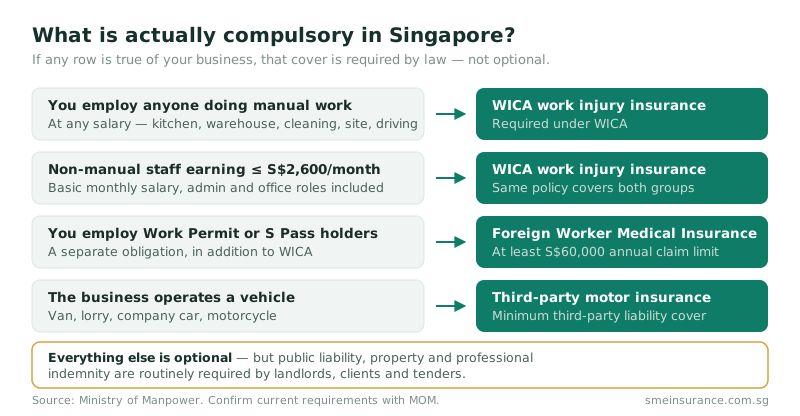
The three compulsory covers, in brief
- Work injury compensation (WICA) insurance. Under WICA, you must insure all employees doing manual work regardless of salary, plus all non-manual employees earning S$2,600 a month or less. Going without is an offence — a fine of up to S$10,000, up to 12 months' jail, or both. For accidents from 1 November 2025, insured compensation runs up to S$269,000 for death, S$346,000 for total permanent incapacity, and S$53,000 in medical expenses.
- Foreign Worker Medical Insurance (FWMI). MOM requires medical insurance with at least a S$60,000 annual claim limit for every Work Permit and S Pass holder — fully in effect since 1 July 2025. This is separate from and additional to WICA cover for the same worker.
- Motor insurance. Under the Motor Vehicles (Third-Party Risks and Compensation) Act, any vehicle used on Singapore roads must carry at least third-party liability cover. That includes company cars, vans, and lorries.
Confirm current requirements with MOM and the relevant authority before relying on any summary — thresholds and limits do change.
Compulsory-cover checklist by situation
| Your situation | Legally required | Commonly required by contract |
|---|---|---|
| Sole director, no employees, no vehicle, home office | Nothing | PI if clients demand it |
| You hire your first local employee | WICA insurance if they do manual work or earn ≤S$2,600/month | — |
| You hire a Work Permit or S Pass holder | WICA insurance and FWMI (≥S$60,000 annual limit) | — |
| You lease an office, shop or F&B unit | Nothing new by statute | Public liability and property cover, per the lease |
| You buy or lease a business vehicle | Third-party motor insurance minimum | Comprehensive cover if financed |
| You do renovation or construction works | WICA for your workers | Contractors' all-risks and public liability, per MCST/landlord/main contractor |
| You practise a regulated profession (law, medicine, real estate, fund management) | Check your licensing body | Professional indemnity is often a licensing condition |
| You tender for government or mall contracts | Nothing new by statute | Public liability at specified limits is standard |
"Not compulsory" doesn't mean "safe to skip"
The compulsory list is short because Singapore leaves most risk decisions to the market — and the market fills the gap through contracts. In practice:
- Landlords and mall operators routinely require public liability cover (often S$1 million or more) and sometimes fire/property cover before handing over keys.
- Main contractors and government tenders specify public liability and contractors' all-risks limits as a condition of award.
- Professional bodies in law, accountancy, medicine, real estate and fund management commonly require professional indemnity as a condition of practising.
- Clients increasingly ask consultancies and tech vendors for proof of PI or cyber cover before signing.
So the practical question is rarely "what does the law require?" — it's "what do my lease, my licences and my contracts require?" Read those documents before you budget.
What happens if you skip a compulsory cover
Skipping WICA insurance for an employee you must insure is a criminal offence — up to S$10,000 in fines, up to 12 months' imprisonment, or both — and if that employee is injured, your company remains liable for the full compensation award out of its own pocket. Employers who fail to maintain FWMI for a foreign worker breach their work pass conditions with MOM, which can affect the ability to hire foreign workers at all. Driving an uninsured vehicle is an offence under the Motor Vehicles (Third-Party Risks and Compensation) Act. None of these are risks worth running to save a few hundred dollars of premium.
A sensible starting portfolio for a typical SME
Most established SMEs end up carrying a core set of covers even though only some are compulsory:
- WICA insurance — compulsory for most workforces, and many employers extend it to the whole team.
- FWMI — compulsory if you employ Work Permit or S Pass holders.
- Public liability — usually contract-driven; indicatively from around S$100–400 a year per S$1 million of cover.
- Property / office package — protects your own fit-out, stock and equipment.
- Professional indemnity — if you sell advice, design or professional services.
Actual premiums depend on your business — get quotes rather than budgeting from ranges.
Frequently asked questions
Is business insurance compulsory in Singapore?
Only three covers are compulsory for a typical business: WICA work injury insurance for manual workers and non-manual employees earning S$2,600/month or less, Foreign Worker Medical Insurance for every Work Permit and S Pass holder, and third-party motor insurance for any business vehicle. All other business insurance is legally optional, though often required by leases, licences and client contracts.
Is public liability insurance compulsory in Singapore?
No, public liability insurance is not legally compulsory in Singapore. However, it is very commonly required by landlords, mall operators, main contractors and government tenders as a condition of your lease or contract — so in practice many businesses cannot operate without it.
Do I need insurance for a company with no employees?
If you have no employees and no vehicle, no business insurance is legally compulsory. You may still want professional indemnity if you sell advice or services, and clients or landlords may require cover contractually. The moment you hire anyone doing manual work — or anyone earning S$2,600/month or less — WICA insurance becomes mandatory.
What insurance do I need to hire a foreign worker in Singapore?
You need two separate covers: WICA work injury insurance (if the worker does manual work or earns S$2,600/month or less) and Foreign Worker Medical Insurance with at least a S$60,000 annual claim limit, which MOM requires for every Work Permit and S Pass holder. One does not substitute for the other. Confirm current requirements with MOM before hiring.
What is the penalty for not having WICA insurance?
Failing to insure an employee you're required to insure under WICA carries a fine of up to S$10,000, imprisonment of up to 12 months, or both. You also remain personally liable for any compensation owed to an injured uninsured employee — awards can reach S$346,000 for total permanent incapacity under the limits applying from 1 November 2025.
Is professional indemnity insurance mandatory in Singapore?
Not by general law — but several professional bodies effectively make it mandatory for their members, including in law, accountancy, medicine, real estate and fund management. Check your licensing body's current rules, and expect many client contracts to require PI regardless.
Related cover & guides
Work Injury Compensation (WICA) Insurance
Compulsory cover for workplace injuries. Required for all manual workers and non-manual staff earning ≤S$2,600/month.
Read more →Foreign Worker Medical Insurance (FWMI): MOM Requirements
Mandatory medical cover for every Work Permit and S Pass holder — at least S$60,000 annual claim limit, separate from WICA.
Read more →Public Liability Insurance
Covers third-party injury and property damage. Not legally compulsory, but contractually required almost everywhere.
Read more →How Much Does Business Insurance Cost in Singapore?
Indicative premium ranges for every major SME cover, plus a worked budget example and the factors that move your price.
Read more →