
Marine cargo insurance covers physical loss or damage to goods while they're being transported — despite the name, that includes air freight and land transit as well as sea. For a Singapore trading, importing or distribution business, it's the cover that stands between you and a container lost overboard, a pallet crushed in handling, or a warehouse-to-port truck accident.
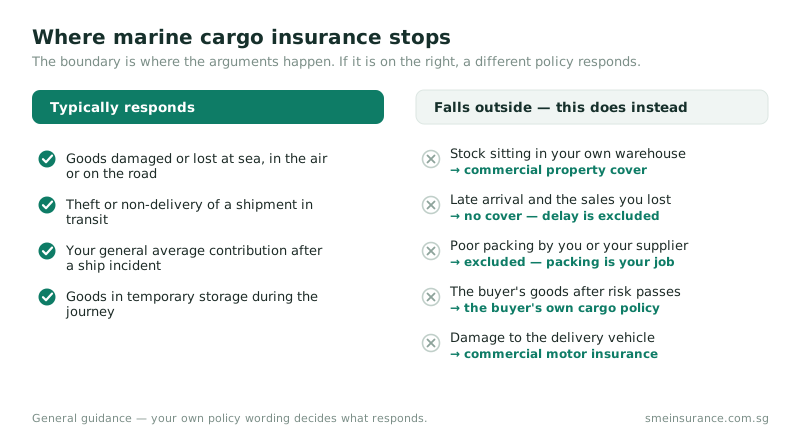
What marine cargo insurance covers
A cargo policy typically covers physical loss of or damage to your goods during transit, from causes such as:
- Vessel or vehicle accidents — sinking, collision, overturning, derailment
- Fire and explosion
- Loss of containers overboard, and general average contributions (explained below)
- Theft, pilferage and non-delivery, depending on the cover level
- Handling damage during loading and unloading, depending on the cover level
Cover is commonly written on standard institute clauses at different breadths — the widest form covers most accidental loss or damage, while narrower, cheaper forms confine cover to listed major casualties. Wetting, contamination and temperature deviation for sensitive cargo can be addressed with the right form and extensions, but poor packing, inherent vice (goods that deteriorate by nature) and ordinary leakage are typically excluded.
One term worth knowing: general average. In a maritime emergency, losses deliberately incurred to save the voyage (jettisoned cargo, salvage costs) are shared by all cargo owners on the vessel — meaning you can owe money even when your own goods arrive intact. Cargo insurance responds to general average claims; uninsured shippers must post security in cash to get their goods released.
| Clause set | Breadth of cover | Typically used for |
|---|---|---|
| Institute Cargo Clauses (A) | The broadest of the three — an all-risks form, subject to the exclusions in the wording | General, fragile or higher-value cargo, and where a buyer or letter of credit specifies the widest form |
| Institute Cargo Clauses (B) | Narrower — a named-perils form, covering fewer causes of loss than (A) | Lower-value or robust cargo where the named perils genuinely match the risks of the route |
| Institute Cargo Clauses (C) | The narrowest of the three — a named-perils form of more limited breadth than (B) | Bulk or low-value commodities where major casualty cover is the priority |
Exactly which perils each set names, and what each excludes, is set by the clause wording attached to your policy — that wording governs, not a summary. Match the clause set to the cargo and the route rather than defaulting to the cheapest form.
Incoterms: who actually bears the risk
Before buying cargo cover, work out which legs of the journey are at your risk — and that's set by the Incoterms on your sales contracts, not by who arranged the freight. Loosely:
- Buying EXW or FOB? Risk transfers to you early — at the seller's premises (EXW) or once goods are on board the vessel (FOB). As the buyer, most of the transit is your problem, and you should insure it.
- Buying CIF? The seller arranges insurance to the destination port — but often only at minimum cover levels, and claims are settled on the seller's policy terms. Many importers prefer to buy on FOB terms and control their own, broader insurance.
- Selling on CIF or CIP? You're contractually obliged to insure the goods for the buyer's benefit — CIP under current Incoterms requires the widest institute cover level unless the parties agree otherwise.
The common failure mode: an importer assumes "the supplier's freight forwarder handles it", a shipment is damaged, and it turns out risk passed at the loading port with no policy in place. Match your insurance to your Incoterms on every trade lane, and confirm the details with a licensed professional if your contracts are mixed.
Open cover vs per-shipment policies
There are two ways to buy cargo insurance:
- Per-shipment (voyage) policies insure one consignment at a time. Fine for occasional or one-off shipments — but administratively painful beyond a few shipments a year, and it only takes one busy week for a consignment to travel uninsured because nobody arranged the certificate.
- Open cover (annual) policies automatically insure all shipments falling within agreed limits — per-shipment maximums, trade lanes, cargo types — for a year, with declarations made periodically. Premiums are typically charged as a rate on the declared values. For any business shipping regularly, open cover is usually cheaper per shipment, and, more importantly, removes the risk of the forgotten one.
Rates vary with the cargo (electronics and perishables rate differently from machinery), the route, the mode — air freight generally rates lower than sea for like cargo because transit is shorter — and packing standards. Premiums are quoted case by case; there's no meaningful standard price for cargo cover, so get quotes on your actual trade pattern.
Air, sea and land: covering the whole journey
Modern cargo policies are usually written warehouse to warehouse — cover attaches when goods leave the origin warehouse and continues through loading, main carriage, transhipment and the final delivery leg. That matters because a large share of transit losses happen on land: in trucking, in port handling, in temporary storage awaiting connection.
Points to check for a Singapore trader:
- Local and cross-border trucking — deliveries to Malaysia and regional road freight can be included under the same policy rather than insured ad hoc.
- Storage in transit — cover usually continues for a limited period during ordinary transhipment; goods sitting long-term in a warehouse need property insurance instead, so mind the handover point with your commercial property cover.
- Duty and increased value — goods can be insured at cost plus freight plus a margin (commonly cost + 10%) so a claim also covers duty and expected profit, not just the invoice price.
Frequently asked questions
What does marine cargo insurance cover?
Marine cargo insurance covers physical loss or damage to goods while in transit — by sea, air or land — from perils such as vessel casualties, fire, container loss, theft and handling damage, with the breadth depending on the clauses chosen. Policies are usually written warehouse to warehouse, so the road legs and transhipments are covered as well as the main voyage. Poor packing, inherent deterioration and ordinary wear are typically excluded.
Do I need cargo insurance if the shipping line is responsible for my goods?
Yes, in most cases — carrier liability is not a substitute for cargo insurance. Shipping lines, airlines and forwarders limit their liability under international conventions and their own terms, often to a fraction of your goods' value, and they pay only where fault is established. Cargo insurance pays for the loss first and lets the insurer pursue the carrier afterwards.
How do Incoterms affect who needs to insure a shipment?
Incoterms decide when risk in the goods passes from seller to buyer, and whoever is on risk for a leg of the journey needs the insurance for that leg. Buying FOB puts most of the transit at the buyer's risk from loading onwards; buying CIF means the seller insures to the destination port, though often only at minimum cover levels; selling CIF or CIP obliges you to insure for your buyer. Check the term on each trade lane before assuming someone else's policy protects you.
What is open cover in cargo insurance?
Open cover is an annual arrangement that automatically insures all your shipments within agreed limits — per-shipment maximums, routes and cargo types — instead of insuring each consignment separately. For businesses that ship regularly it's usually cheaper per shipment and removes the biggest practical risk of per-shipment buying: the consignment nobody remembered to insure. Values are declared periodically and premium is charged on what actually shipped.
What is general average, and why does it matter to me?
General average is a maritime rule under which losses deliberately incurred to save a voyage — cargo jettisoned, salvage costs — are shared proportionally by everyone with cargo on the vessel. It means you can face a bill even when your own goods arrive undamaged, and uninsured cargo owners must post cash security before their goods are released. A cargo policy responds to general average contributions on your behalf.
Related cover & guides
Insurance for Logistics & Transport Companies
Compulsory motor cover, goods-in-transit vs marine cargo, warehouse property and WICA for drivers — logistics insurance explained.
Read more →Commercial Motor & Fleet Insurance
Compulsory third-party cover for every vehicle under Singapore law, plus comprehensive and fleet options for business use.
Read more →Commercial Property & Fire Insurance
Protects premises, renovation, stock and equipment against fire and other damage. Often required under your tenancy agreement.
Read more →How Much Does Business Insurance Cost in Singapore?
Indicative premium ranges for every major SME cover, plus a worked budget example and the factors that move your price.
Read more →