
A small Singapore business typically spends a few hundred to a few thousand dollars a year on insurance, depending on headcount and industry. As rough, indicative anchors: public liability runs from around S$100–400 a year per S$1 million of cover, professional indemnity from around S$300–800 a year for small firms, an office package from around S$200–500 a year, cyber insurance from around S$500–1,500 a year, and commercial motor around S$1,000–2,500 per vehicle per year. Actual premiums depend on your business — treat every figure on this page as a sense-check, not a quote.
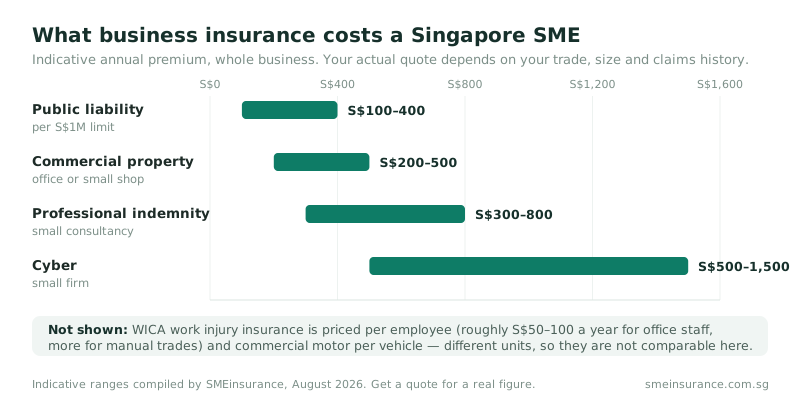
Indicative annual premiums by cover type
| Cover | Indicative annual premium | Priced mainly on |
|---|---|---|
| Public liability | From ~S$100–400 per S$1M limit | Industry risk, footfall, revenue |
| Professional indemnity | From ~S$300–800 (small firms) | Profession, fees/revenue, limit |
| Office package / property | From ~S$200–500 | Sum insured, location, contents |
| Cyber insurance | From ~S$500–1,500 (small firms) | Revenue, data held, security posture |
| Commercial motor | ~S$1,000–2,500 per vehicle | Vehicle type, usage, driver history |
| Group employee benefits | From ~S$300–800 per employee | Headcount, age profile, plan design |
| WICA work injury | From ~S$50–100 (office) to several hundred per worker (high-risk trades) | Occupation class, payroll |
All figures are indicative only and skew towards small, low-claims businesses. Higher limits, riskier trades and past claims push premiums above these ranges — sometimes well above.
Worked example: a 5-person café
A 5-person café leasing a small unit might budget roughly like this, purely as an illustration:
- WICA insurance for five staff doing light manual work at roughly S$100–300 each: about S$500–1,500 a year.
- Public liability at S$1 million (likely a lease requirement): roughly S$100–400 a year.
- Property/contents cover for fit-out, kitchen equipment and stock: roughly S$200–500 a year.
That's an indicative total of around S$800–2,400 a year before any optional extras such as business interruption or group medical benefits. If the café employs Work Permit holders, add mandatory FWMI per worker on top. A real quote could land outside this range in either direction — this is a budgeting sketch, not a price.
What pushes premiums up
- Industry risk. Construction, logistics and F&B pay more than desk-based consultancies for the same limits — more ways for people and property to get hurt.
- Claims history. Past claims are the strongest single predictor insurers use. A clean record earns better pricing; repeated claims can make cover hard to place at all.
- Higher limits and lower excesses. Doubling a liability limit doesn't usually double the premium, but it always raises it; choosing a very low excess raises it too.
- Revenue and headcount. Most liability covers scale with the size of your operations.
- Specific exposures. Working at height, handling customer data at scale, hot works, high-value stock — each drags its own loading.
What brings premiums down
- Accurate declarations. Precisely described work scope avoids being rated for risks you don't actually run — and protects your claims.
- Risk management you can evidence. Fire protection, staff safety training, cyber hygiene (MFA, backups) and CCTV all help at underwriting.
- Sensible excesses. Carrying a modest excess yourself, rather than insuring the first dollar, usually cuts premium meaningfully.
- Packaging. Bundled SME packages (property + liability + money + glass) are often cheaper than buying each cover separately.
- Shopping the market. Pricing varies significantly between insurers for identical risks — comparing quotes is the easiest saving available.
Frequently asked questions
How much does business insurance cost in Singapore?
Indicatively, a small Singapore business spends a few hundred to a few thousand dollars a year: public liability from around S$100–400 per S$1 million of cover, professional indemnity from around S$300–800, an office package from around S$200–500, and cyber from around S$500–1,500 for small firms. Actual premiums depend on your industry, revenue, headcount and claims history — get a quote for a real figure.
How much is public liability insurance in Singapore?
Indicatively from around S$100–400 a year per S$1 million of cover for a low-risk small business. Higher-risk trades such as construction or F&B, higher limits, and larger revenues push the premium up. Actual quotes vary by insurer and your specific operations.
What insurance costs should a new SME budget for?
Budget first for the compulsory covers — WICA insurance if you employ staff, FWMI if any hold Work Permits or S Passes, and motor insurance for any vehicle — then add what your lease or contracts require, usually public liability. A small service business might start at several hundred dollars a year; an F&B or trades business with staff, more.
Why did my business insurance premium go up?
The usual causes are claims (yours or your industry's), growth in revenue or headcount, expanded work scope, or market-wide rate increases after major loss years. If nothing about your business changed, ask for a breakdown and compare quotes — pricing for the same risk varies between insurers.
Is cheaper business insurance worth it?
Only if the cover is genuinely comparable — a cheaper policy with lower limits, wider exclusions or a higher excess isn't a saving, it's a different product. Compare the limit, the excess and the key exclusions before comparing the price, and ask a licensed professional to explain any difference you don't understand.
Related cover & guides
Is Business Insurance Compulsory in Singapore?
Only three covers are legally compulsory for a typical SME. See exactly which apply to your business, and what contracts add on top.
Read more →Public Liability Insurance
Covers third-party injury and property damage. Not legally compulsory, but contractually required almost everywhere.
Read more →Professional Indemnity Insurance
Covers negligence, errors and omissions in professional work. Required by some professional bodies and many B2B contracts.
Read more →Insurance for F&B Businesses
Compulsory WICA for kitchen staff, landlord-required public liability, fire and food poisoning cover — what F&B actually needs.
Read more →