
Professional services firms have the lightest physical risk profile in this guide — no machinery, no stock, no public streaming through the premises — and one concentrated exposure that outweighs everything else: professional liability. A misstated report, a design error that reaches production, a missed filing deadline, campaign advice that backfires — these become claims for the client's financial loss, and the defence costs alone can outrun a small firm's cash.
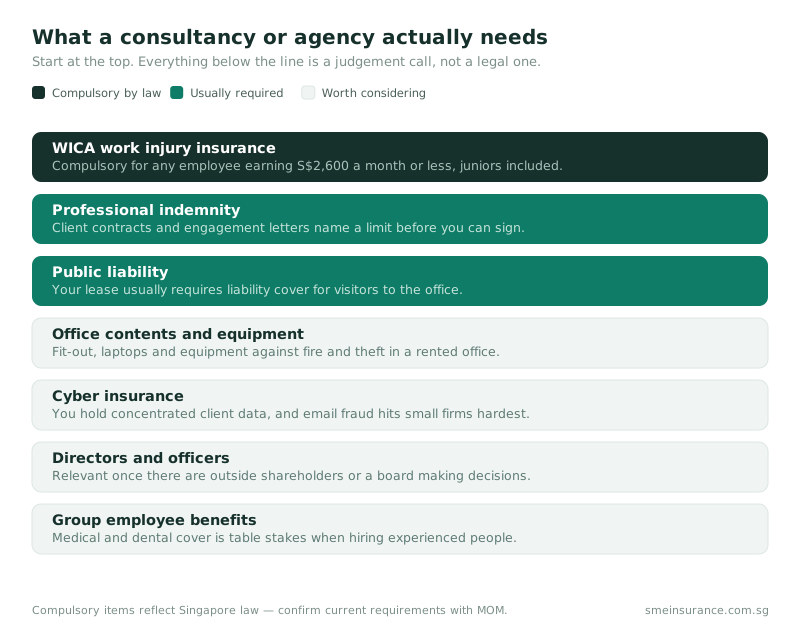
At a glance: what you need, and why
| Cover | Status | Why it matters here |
|---|---|---|
| WICA work injury insurance | Compulsory | Compulsory for any employee earning S$2,600 a month or less, juniors included. |
| Professional indemnity | Usually required | Client contracts and engagement letters name a limit before you can sign. |
| Public liability | Usually required | Your lease usually requires liability cover for visitors to the office. |
| Office contents and equipment | Worth considering | Fit-out, laptops and equipment against fire and theft in a rented office. |
| Cyber insurance | Worth considering | You hold concentrated client data, and email fraud hits small firms hardest. |
| Directors and officers | Worth considering | Relevant once there are outside shareholders or a board making decisions. |
| Group employee benefits | Worth considering | Medical and dental cover is table stakes when hiring experienced people. |
Professional indemnity: the core cover
Professional indemnity (PI) covers your legal liability for claims that your professional work — advice, designs, reports, filings, project deliverables — was negligent and caused a client financial loss. Critically, it also pays defence costs, which arrive whether or not a claim has merit.
Three practical points for a small firm:
- Size the limit to your contracts, not your revenue. Clients typically specify required limits — S$1 million is a common floor, larger corporates and government tenders ask for more. Your exposure is your client's potential loss, which can dwarf your fee.
- PI is claims-made. The policy in force when the claim is made responds — not the one in force when the work was done. Keep cover continuous, and if you wind down or merge, arrange run-off cover so past work stays protected.
- Declare your actual activities. A management consultancy that quietly drifts into implementation work, or an agency that starts building software, may find claims from the new activity outside the declared scope.
Full detail in our professional indemnity guide and what is professional indemnity? explainer.
What your engagement letters and clients will require
In this sector, insurance requirements arrive through procurement. Corporate clients and government tenders commonly require evidence of PI at a stated limit, sometimes public liability as well, and increasingly cyber cover for vendors handling their data — verified via certificates of currency before onboarding. Losing a tender for want of a certificate is a cheap lesson to avoid.
Two contract habits protect you as much as any policy: cap your liability in engagement letters where clients will accept it (your PI insurer will ask about this), and don't sign indemnities broader than your policy covers — uninsured contractual liability is a gap you created yourself. For regulated professions, remember professional-body PI requirements set a floor that client demands may exceed; comply with both.
Cyber, office and the rest of the programme
- Cyber insurance. Professional firms hold concentrated client data — financials, deal information, unreleased designs — and email-driven fraud and ransomware hit small firms disproportionately. Cyber cover pays for incident response, legal and notification costs, restoration and related third-party claims; indicatively S$500–1,500 a year for a small firm. See cyber insurance.
- Office package. Contents, equipment and fit-out against fire and theft, usually with public liability for visitors bundled in — from around S$200–500 a year. Your landlord may require the liability element in the lease.
- WICA insurance. Even a desk-bound firm must insure any employee earning S$2,600 a month or less — juniors, admin staff, interns — and any staff doing manual work (an office cleaner on your payroll counts). Penalty for non-compliance: a fine of up to S$10,000, up to 12 months' jail, or both. Many firms insure the whole team; office-staff premiums are indicatively S$50–100 per person per year. See the WICA guide.
- Group medical and employee benefits (indicatively S$300–800 per employee per year) if you're competing for talent, and D&O once outside shareholders or a substantial board are involved.
What it roughly costs
A professional services firm is cheap to insure relative to its revenue. Indicatively:
- PI: from around S$300–800 a year for a small, low-risk firm at a S$1 million limit — higher for larger limits, higher-risk disciplines (e.g. work touching construction or financial advice) or claims history.
- Cyber: from around S$500–1,500 a year for small firms.
- Office package: from around S$200–500 a year.
- WICA: from around S$50–100 per office employee per year.
A five-person consultancy might run a complete programme for roughly S$1,000–3,000 a year. Actual premiums depend on your discipline, client base and limits — get quotes against your real contract requirements.
Frequently asked questions
Is professional indemnity insurance compulsory in Singapore?
Not by general statute — but professional bodies may require PI as a condition of practice for professions such as law, accountancy, medicine, real estate and fund management, and client contracts routinely require it regardless of profession. For most consultancies and agencies, the practical answer is that you need it to win and keep serious clients, whatever the law says. Check your own professional body's current requirements.
How much professional indemnity cover does a small consultancy need?
Start from what your client contracts specify — S$1 million is a common minimum, with larger corporates and government tenders often requiring more. Beyond contract minimums, size the limit to the financial damage an error in your work could cause a client, which usually far exceeds your fee. A licensed professional can benchmark limits for your discipline.
Does my PI policy cover work I did before I bought it?
Only if the policy includes retroactive cover reaching back to when the work was done — PI is claims-made, so it's the policy in force when the claim arrives that responds, subject to its retroactive date. When switching insurers, preserve your retroactive date; when closing the firm, arrange run-off cover so claims about past work remain insured.
Do I need public liability insurance for an office-based business?
It's rarely demanded by law, but your lease may require it and it's usually bundled cheaply into an office package anyway — covering visitor injuries on your premises. For an office-based firm it's a minor line item; PI and cyber are where the real exposure sits.
Do I need WICA insurance if my whole team works at desks?
Yes, if anyone earns S$2,600 a month or less — WICA insurance is compulsory for those employees even in non-manual roles, and for anyone doing manual work regardless of pay. Firms with juniors, interns or admin staff below the threshold have a legal obligation; many simply insure everyone, since office-staff premiums are modest.
Related cover & guides
Professional Indemnity Insurance
Covers negligence, errors and omissions in professional work. Required by some professional bodies and many B2B contracts.
Read more →Cyber Insurance
Covers ransomware, data breaches, email fraud and PDPA fallout — response costs, lost income and third-party claims.
Read more →Work Injury Compensation (WICA) Insurance
Compulsory cover for workplace injuries. Required for all manual workers and non-manual staff earning ≤S$2,600/month.
Read more →Public Liability vs Professional Indemnity: The Difference
PL covers injury and property damage you cause; PI covers financial loss from your advice. Scenario table shows which pays when.
Read more →