Directors and officers liability insurance protects the people who run a company — directors, officers and often senior managers — against personal liability for the decisions they make in that role, and pays the legal costs of defending claims and investigations. The company's limited liability doesn't extend to its directors: under Singapore's Companies Act, directors owe personal duties to act honestly, diligently and in the company's interests, and can be pursued personally when someone alleges they fell short.
Why directors' liability is personal
Under the Companies Act, directors owe duties to the company — including duties to act honestly and use reasonable diligence — and breaches can bring civil claims and, in serious cases, criminal consequences. In practice, claims and investigations against directors of Singapore SMEs tend to come from:
- Shareholders and investors — allegations of mismanagement, misleading statements during fundraising, oppression of minority shareholders, disputes between founders.
- Regulators and authorities — investigations and enforcement in regulated sectors, and directors' exposure for company offences in areas like employment and workplace safety.
- Creditors and liquidators — when a company fails, liquidators review directors' past decisions, and trading while insolvent gets scrutinised hard.
- Employees and third parties — claims naming directors personally alongside the company.
The uncomfortable feature of all of these: defence costs arrive immediately and personally, even for a director who ultimately did nothing wrong. Funding the defence is the core of what D&O does.
Side A, B and C — explained plainly
D&O policies are built from three insuring clauses. The jargon is impenetrable; the ideas aren't:
| Clause | Who it pays | In plain terms |
|---|---|---|
| Side A | The director personally | Pays a director's defence costs and liability when the company cannot indemnify them — because it's insolvent, or the law doesn't allow it. This is the clause that protects a director's own house and savings. |
| Side B | The company | Reimburses the company when it does indemnify a director for a claim — the company fronts the costs, the policy pays the company back. |
| Side C | The company itself | Covers claims against the company as an entity, typically limited to securities-related claims. More relevant to listed and fundraising companies than to typical SMEs. |
One consequence worth understanding: all three sides usually share a single policy limit. In a bad year, entity claims (Side C) can erode the limit that individual directors were counting on — one reason boards with meaningful personal exposure pay attention to the limit, not just the premium.
What D&O covers — and what it never will
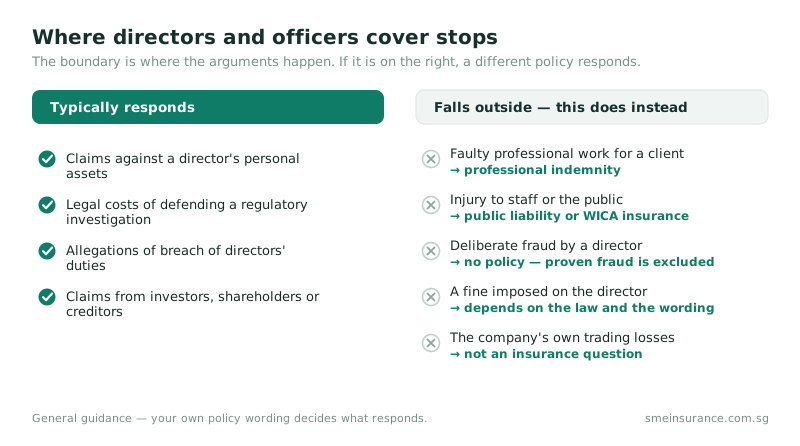
A D&O policy typically covers defence costs, investigation costs, and settlements or damages arising from claims against directors and officers for alleged wrongful acts in managing the company — negligent decisions, misstatements, breaches of duty. Cover usually extends to past, present and future directors, and often to spouses and estates where a director's personal exposure passes to them.
What it will not cover, anywhere in the market:
- Fraud and dishonesty — proven deliberate wrongdoing is excluded, though defence costs are typically funded until such conduct is established.
- Personal profit the director wasn't entitled to.
- Known claims and circumstances — D&O is claims-made, like professional indemnity: the policy in force when a claim is made responds, so continuity of cover matters, and issues known before inception are excluded.
- Professional services to clients — a client suing over bad service is a PI claim, not a D&O claim. The two covers answer different questions: PI protects the firm's work; D&O protects its leadership's decisions.
When SMEs actually buy it
In practice, Singapore SMEs buy D&O at identifiable trigger points:
- Taking external investment. Venture and private equity investors routinely require D&O cover as a condition of investment — and incoming investor-appointed directors ask for it before joining the board. For a fundraising startup, this is often the moment D&O appears.
- Recruiting independent or external directors, who increasingly decline board seats at uninsured companies.
- Operating regulated activities, where investigations are a live possibility and their defence costs are substantial regardless of outcome.
- Expansion, restructuring or distress — cross-border operations, M&A, and financial difficulty all sharpen scrutiny of board decisions.
Premiums are quoted case by case on the company's size, sector, financial health and shareholder structure; there's no meaningful standard price, and terms tighten quickly for companies in financial difficulty — which is precisely when buying cover gets hardest. Actual premiums depend on your business, so get quotes early rather than at the point of need.
Frequently asked questions
What does D&O insurance cover?
D&O insurance covers directors and officers personally against claims arising from their management decisions — paying defence costs, investigation costs and, where liability is established, settlements and damages for alleged wrongful acts such as breaches of duty, negligent decisions and misstatements. It also reimburses the company when it indemnifies its directors. Proven fraud, dishonesty and personal profit a director wasn't entitled to are excluded everywhere in the market.
Do directors of private companies in Singapore really face personal liability?
Yes. Under the Companies Act, directors' duties — to act honestly, diligently and in the company's interests — are owed personally, and shareholders, regulators, liquidators and creditors can pursue directors as individuals; incorporation protects shareholders' capital, not directors' conduct. Even claims that ultimately fail generate immediate, personal defence costs, which is the exposure D&O most reliably answers.
What do Side A, Side B and Side C mean in a D&O policy?
Side A pays a director personally when the company cannot indemnify them — the clause that protects personal assets; Side B reimburses the company when it does indemnify its directors; Side C covers claims against the company itself, usually limited to securities claims. All three typically share one policy limit, so entity claims can erode the cover individual directors rely on — worth remembering when choosing the limit.
Does my company need D&O if I'm the only director and shareholder?
The case is weaker but not empty: you won't sue yourself as a shareholder, but regulators, creditors, liquidators and employees can still pursue you personally, particularly if the company hits financial difficulty. Sole owner-directors of simple, solvent businesses often prioritise other covers first; the calculus changes the moment you take investment, add directors or enter regulated activity.
What's the difference between D&O and professional indemnity insurance?
Professional indemnity covers the company's professional work — claims that your services or advice caused a client financial loss — while D&O covers the people running the company for their management decisions. A design error is a PI claim; a shareholder alleging the board mismanaged the company is a D&O claim. Service firms with boards and external investors often need both, and the policies are designed to sit alongside each other.
When should a startup buy D&O insurance?
Typically at the first external fundraise — investors commonly require D&O as a condition of investment, and investor-appointed directors expect cover to be in place before they join the board. Buying at that point is also practical underwriting-wise: terms are easiest to obtain while the company is healthy, and D&O is claims-made, so earlier, continuous cover protects earlier decisions.
Related cover & guides
Insurance for Tech Startups
Tech E&O for client contracts, cyber cover, D&O for funded startups, group benefits — and the WICA rule founders miss.
Read more →Professional Indemnity Insurance
Covers negligence, errors and omissions in professional work. Required by some professional bodies and many B2B contracts.
Read more →Business Insurance for New Companies in Singapore
Day-one insurance checklist for fresh incorporations: what each milestone — first hire, premises, vehicle, contract — triggers.
Read more →Insurance for Professional Services Firms
PI as the core cover, client contract requirements, cyber for client data and an office package — insurance for firms that sell expertise.
Read more →