Manufacturers face two kinds of loss that other SMEs largely do not. The first is severity: a fire in a factory unit does not take out a laptop, it takes out several hundred thousand dollars of plant and every order in the book. The second is dependency — most small manufacturers run one line, one CNC machine or one oven that everything passes through, so a single mechanical failure stops the whole business rather than slowing it.
Add a workforce doing manual work all day, often on Work Permits, and the compulsory obligations are unavoidable from day one. Manufacturing sits in the highest-risk classification for work injury purposes, which is reflected directly in what WICA cover costs per head.
At a glance: what you need, and why
| Cover | Status | Why it matters here |
|---|---|---|
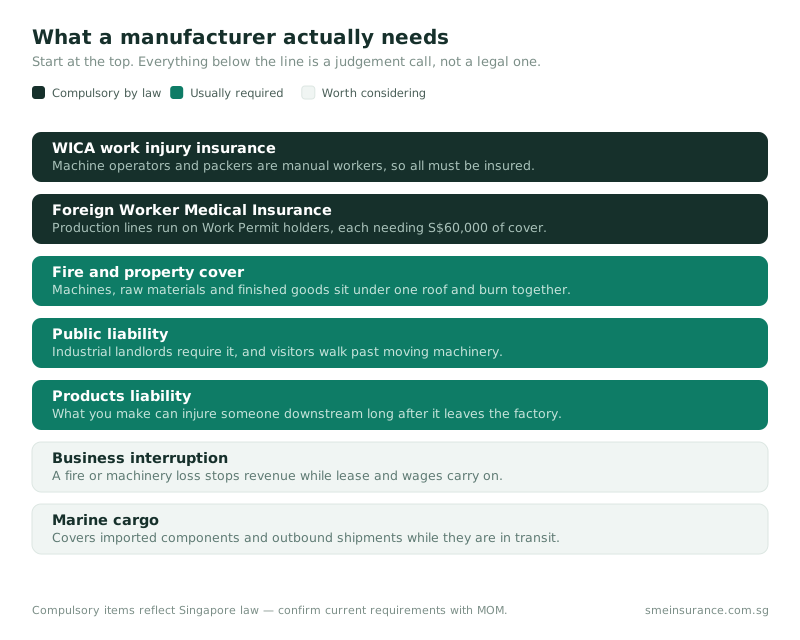
| WICA work injury insurance | Compulsory | Machine operators and packers are manual workers, so all must be insured. |
| Foreign Worker Medical Insurance | Compulsory | Production lines run on Work Permit holders, each needing S$60,000 of cover. |
| Fire and property cover | Usually required | Machines, raw materials and finished goods sit under one roof and burn together. |
| Public liability | Usually required | Industrial landlords require it, and visitors walk past moving machinery. |
| Products liability | Usually required | What you make can injure someone downstream long after it leaves the factory. |
| Business interruption | Worth considering | A fire or machinery loss stops revenue while lease and wages carry on. |
| Marine cargo | Worth considering | Covers imported components and outbound shipments while they are in transit. |
Your compulsory obligations start on the shop floor
- Work injury compensation (WICA) insurance. Machine operators, assemblers, packers, forklift drivers, QC staff, technicians — all manual work, which means under WICA they must be insured regardless of salary. Non-manual staff such as an office administrator or a sales executive must be insured if they earn S$2,600 a month or less. Not holding cover where the law requires it is an offence carrying a fine of up to S$10,000, up to 12 months' jail, or both. For accidents from 1 November 2025 the compensation limits run from S$91,000 to S$269,000 for death, S$116,000 to S$346,000 for total permanent incapacity, and medical expenses up to S$53,000 or one year, whichever comes first. Our WICA guide sets out how claims work.
- Foreign Worker Medical Insurance (FWMI). Every Work Permit and S Pass holder must have medical insurance with at least a S$60,000 annual claim limit — the enhanced requirement fully in effect since 1 July 2025, with age-differentiated premiums and insurer/employer co-payment above set thresholds. FWMI and WICA are separate obligations; holding one does not satisfy the other. Confirm current requirements with MOM.
Workplace safety and health obligations sit alongside all of this and are enforced separately — insurance does not discharge them, and a poor safety record shows up in your renewal terms as surely as it does in an inspection.
Fire, property and the sum insured that is usually wrong
Commercial property insurance — fire and extended perils, or a broader all-risks form — covers the building where you own it, your machinery and plant, fixtures, stock and raw materials. For a manufacturer the sums insured are large enough that getting them wrong has consequences.
Two points do most of the damage in practice:
- Insure for reinstatement, not book value. A depreciated machine on your balance sheet may be worth a fraction of what a replacement costs today, and replacement is what you would actually have to do. Insuring at book value is how businesses discover average — the proportional reduction insurers apply when a property is underinsured, which cuts every claim, not just total losses.
- Declare stock realistically and seasonally. Raw material and finished goods values swing with your order book. A sum insured set at a quiet month's holding is inadequate in your peak month.
Fire cover for industrial premises also comes with conditions attached: housekeeping, hot works controls, storage of flammables, electrical maintenance records. Underwriters ask, surveyors verify, and a breach of a policy condition is a fast route to a declined claim. Where you occupy a JTC or private industrial unit, the tenancy will additionally set out what you must insure and what the landlord insures — read that clause rather than assuming the building policy protects your machines.
Machinery breakdown: the cover people assume they already have
A standard fire or property policy responds to damage from an external, insured peril. It typically does not respond when a machine fails from the inside — a motor burning out, a control board failing, a compressor seizing, an electrical fault within the equipment itself. That is what machinery breakdown insurance is for, and it is bought as a separate section or policy.
Related covers worth pricing at the same time, since they address the same failure:
- Boiler and pressure vessel cover where you operate them, which usually also includes the periodic inspection requirement.
- Deterioration of stock, if a refrigeration or climate-control failure would spoil raw materials or finished goods — essential for food, pharmaceutical and some electronics production.
- Electronic equipment cover for CNC controllers, testing rigs and process computers, which are often excluded or sub-limited under general machinery wordings.
- Machinery breakdown business interruption, which extends income cover to a breakdown rather than only to fire or flood. Without it, the most likely cause of a shutdown is the one your interruption cover ignores.
Product liability and what your buyers put in the contract
Product liability covers your legal liability for injury or property damage caused by goods you manufactured or supplied after they have left your premises. It is normally written as an extension of a public liability policy, with the public liability side covering visitors, delivery drivers and contractors on your site.
Two commercial realities drive the buying decision. First, larger customers — MNCs, main contractors, government-linked buyers, overseas distributors — routinely specify a minimum product liability limit in their purchase terms, and will ask for a certificate before the first delivery. Second, if you manufacture to a customer's design, that does not remove your exposure: a defect in workmanship or materials is yours even when the drawing was theirs, and the contract usually says so in an indemnity clause worth reading before signing.
Check the territorial and jurisdiction limits if you export. Cover that responds in Singapore may not respond to a claim brought in the United States, and that difference is priced deliberately. Also check whether product recall is included — it usually is not, and withdrawing a batch from customers is a separate, specialist cover.
One line down, the whole business down — and what it costs
Business interruption replaces the gross profit you lose while production is halted, and pays the fixed costs that continue anyway. For a manufacturer the critical decision is the indemnity period: not how long repairs take, but how long it takes to source a replacement machine, install and commission it, requalify with your customers and win back orders someone else has been filling in the meantime. For specialised imported plant with a long lead time, a 12-month indemnity period is often too short.
Two related covers complete the picture: marine cargo insurance for imported raw materials and components, where risk frequently passes to you at the origin port and carrier liability is capped far below commercial value; and contingent or supplier-dependency extensions where one supplier feeds your only line.
Indicative annual ranges — genuinely indicative, because manufacturing premiums are driven by process, materials and sums insured more than by headcount:
- WICA: manufacturing sits in the highest work-injury risk classification, so expect the top end of the market rather than office-level pricing; it is quoted as a rate on your annual wage roll.
- Public and product liability: from around S$100–400 a year per S$1 million of cover for low-hazard products, higher for anything safety-critical or exported to litigious markets.
- Property, machinery breakdown and business interruption: rated on your declared sums insured and process rather than a flat range — a light assembly unit and a metal-working shop with a paint line are priced very differently.
Actual premiums depend on your business — get a quote.
Frequently asked questions
Is insurance compulsory for a factory in Singapore?
WICA work injury insurance is — it is compulsory for every employee doing manual work regardless of salary, which covers essentially your whole production floor, and for non-manual employees earning S$2,600 a month or less. Foreign Worker Medical Insurance with at least a S$60,000 annual claim limit is separately compulsory for each Work Permit and S Pass holder. Property, machinery and liability covers are not required by national law, but your landlord, your lender and your customers will usually require them contractually.
Does my fire insurance cover a machine that breaks down?
No — a fire or property policy responds to damage from an external insured peril, not to a machine failing internally. Motor burnout, control-board failure and mechanical seizure fall under machinery breakdown insurance, which is a separate section or policy. This is one of the most common coverage gaps among small manufacturers, because the loss that actually stops production is usually a breakdown rather than a fire.
How much does WICA insurance cost for factory workers?
Manufacturing and light industrial work sits in the highest work-injury risk classification, so it is priced at the top of the WICA range and quoted as a rate applied to your annual wage roll rather than a flat sum per head. Your claims history, your safety record and the specific processes you run move that rate materially, so the only reliable figure is a quote for your own payroll.
Do I need product liability insurance if I manufacture to my customer's design?
Yes — manufacturing to someone else's drawing does not remove your liability for defects in your workmanship or materials, and most supply contracts contain an indemnity clause that puts that risk squarely on the manufacturer. Larger buyers commonly specify a minimum product liability limit and ask for a certificate before your first delivery.
What insurance covers raw materials shipped in from overseas?
Marine cargo insurance covers goods while they are in transit by sea, air or land, including the inland legs at each end. It matters because under many Incoterms risk passes to the buyer at the origin port, and a carrier's liability is limited by international convention to amounts well below the commercial value of a shipment — so a lost container recovers a fraction of what it cost you.
How long should my business interruption indemnity period be?
Long enough to source, install, commission and requalify a replacement machine and win your customers back — which for imported specialist plant is frequently longer than the 12 months many policies default to. Work backwards from the lead time quoted by your equipment supplier, then add the time your buyers would need to move orders back from whoever picked them up.
Related cover & guides
Work Injury Compensation (WICA) Insurance
Compulsory cover for workplace injuries. Required for all manual workers and non-manual staff earning ≤S$2,600/month.
Read more →Commercial Property & Fire Insurance
Protects premises, renovation, stock and equipment against fire and other damage. Often required under your tenancy agreement.
Read more →Business Interruption Insurance
Extends property insurance to replace lost gross profit and continuing costs while you recover from insured damage.
Read more →Marine Cargo Insurance
Covers goods in transit by sea, air and land. Essential for importers and exporters — your Incoterms decide when you're on risk.
Read more →