E-commerce risk is unusual because most of it happens somewhere you are not. Your stock sits in a third-party warehouse or a rented storeroom, moves through a freight forwarder, and finishes its journey with a courier. Your customer data sits with a platform and a payment gateway. Your revenue depends on systems none of which you own. The exposure is real; it is just distributed.
The single most common mistake we see described is the assumption that stock kept at home, or in a small office unit, is covered by an existing policy. Household policies routinely exclude property held for business or trade, and a basic office package insures office contents rather than trading stock. Whichever it is, the money you have tied up in inventory is usually the largest uninsured number in the business.
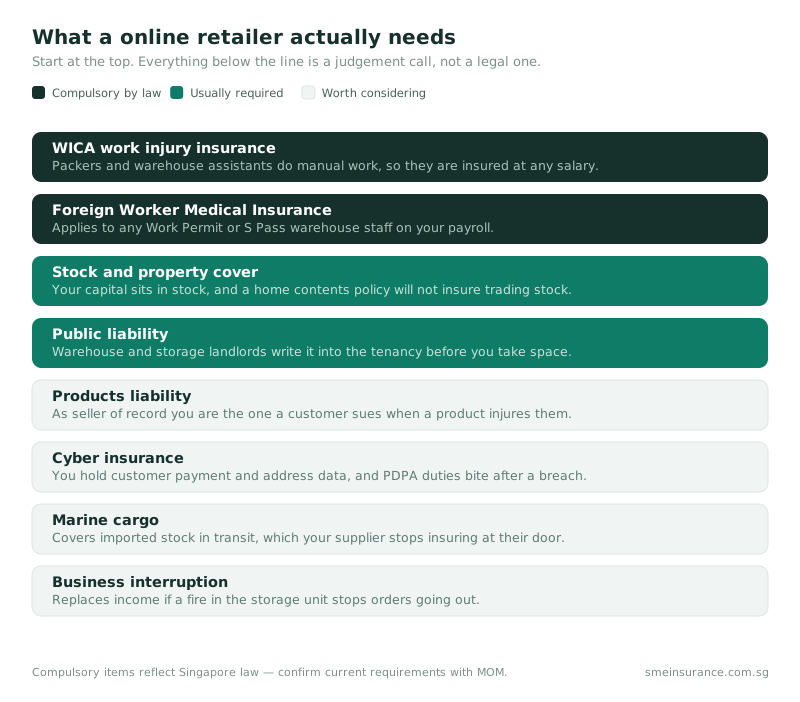
At a glance: what you need, and why
| Cover | Status | Why it matters here |
|---|---|---|
| WICA work injury insurance | Compulsory | Packers and warehouse assistants do manual work, so they are insured at any salary. |
| Foreign Worker Medical Insurance | Compulsory | Applies to any Work Permit or S Pass warehouse staff on your payroll. |
| Stock and property cover | Usually required | Your capital sits in stock, and a home contents policy will not insure trading stock. |
| Public liability | Usually required | Warehouse and storage landlords write it into the tenancy before you take space. |
| Products liability | Worth considering | As seller of record you are the one a customer sues when a product injures them. |
| Cyber insurance | Worth considering | You hold customer payment and address data, and PDPA duties bite after a breach. |
| Marine cargo | Worth considering | Covers imported stock in transit, which your supplier stops insuring at their door. |
| Business interruption | Worth considering | Replaces income if a fire in the storage unit stops orders going out. |
Your stock is probably not insured right now
Work out where your inventory physically is at each stage, then check that each stage is covered:
- At home or in a storeroom. Household and personal contents policies generally exclude goods held for business or sale, so stock in the spare room is typically outside cover. What you need is a commercial property or stock policy that names the location and a realistic sum insured — and you should tell the insurer that the location is residential, because a policy arranged on the wrong basis is a claim waiting to fail.
- In a third-party warehouse or 3PL. A fulfilment provider's own insurance covers the fulfilment provider. Their liability to you is usually capped by their terms — often by weight or by a fixed sum per consignment — which will not resemble the retail value of your goods. Insure your stock in their care under your own policy.
- In transit from your supplier. Goods coming in from overseas need marine cargo insurance. Do not assume the supplier's shipping terms give you cover: under many Incoterms the risk transfers to you long before the container reaches Singapore, and carriers' liability is limited by international convention to figures well below commercial value.
- On its way to the customer. Domestic goods-in-transit cover, or a courier's declared-value option, handles the last leg. For low-value parcels many sellers self-insure this deliberately — that is a legitimate decision, provided it is a decision rather than an oversight.
Liability for what you sell
Product liability covers your legal liability for injury or property damage caused by a product you supplied. It matters more than most online sellers expect, and it applies whether you manufactured the item or simply put your name on someone else's. An injured customer names the business they bought from, so "I only resell it" rarely keeps you out of the claim — and it does not stop the legal costs of arguing the point.
The exposure is concentrated in a few categories: anything electrical or battery-powered, anything applied to skin, anything ingested, anything for babies and children, and anything that bears weight. If you sell in those spaces, product liability — usually written as an extension to a public liability policy — is not optional in practical terms, and your overseas supplier is unlikely to be worth suing.
Two things to check in the wording: whether cover extends to goods you export (many marketplace sellers ship internationally without noticing the policy's territorial limit), and whether product recall costs are included — they usually are not, and recall is a separate, specialist cover.
Data, payments and the PDPA
Every e-commerce business is a data business. You hold names, addresses, phone numbers, order histories and, depending on your setup, partial payment details. Under the Personal Data Protection Act you are responsible for protecting the personal data in your control, and a significant breach can bring notification duties — confirm current requirements with the PDPC. What matters commercially is that the obligation does not transfer to your platform or your payment gateway just because they hold the servers.
Cyber insurance is best understood as a cost-of-response policy. It typically funds forensic investigation, legal advice, customer notification, credit monitoring where relevant, and the cost of responding to a regulator, and it commonly includes cover for cyber extortion and for funds lost to certain kinds of fraudulent payment instruction. What it does not do is fix your security.
The two incidents that actually happen to small online sellers are dull rather than dramatic: an account takeover on a marketplace or ad platform, and a payment-diversion email that convinces someone to pay a supplier invoice into the wrong account. Check how the policy treats both, because social-engineering fraud is frequently sub-limited or excluded.
When the warehouse burns or the platform goes dark
Business interruption cover replaces lost gross profit while your trading is disrupted, and for an online seller it is worth being precise about what triggers it. Standard business interruption responds to interruption following insured physical damage — a fire at your warehouse, flooding in your storeroom. That is a genuine risk when all your stock sits under one roof.
Interruption without physical damage is a different question. If a marketplace suspends your seller account, a payment gateway fails, or a hosting provider has an outage, a conventional business interruption section typically will not respond. Some cyber policies offer a network interruption or system failure extension that covers loss of income from a technology outage, and a supplier-dependency or contingent business interruption extension can be added where one supplier or one 3PL underpins the whole operation. If a single point of failure would stop your revenue, say so at quotation stage and ask how the wording addresses it.
Staff, and what the whole programme roughly costs
The moment you employ packers, pickers or warehouse assistants, WICA work injury insurance is compulsory — they are doing manual work, so they must be insured regardless of salary, while non-manual employees such as a customer-service or marketing hire must be insured if they earn S$2,600 a month or less. Non-compliance is an offence carrying a fine of up to S$10,000, up to 12 months' jail, or both. If any of them hold a Work Permit or S Pass, Foreign Worker Medical Insurance with at least a S$60,000 annual claim limit is a separate and additional requirement. Riders and drivers engaged through platforms have had WICA-equivalent protection since 1 January 2025; how that interacts with your own delivery arrangements is worth confirming with MOM.
Indicative annual ranges, which vary heavily with stock values, product category and turnover:
- Stock and property: from around S$200–500 a year at modest sums insured, scaling with the value of inventory you hold.
- Public and product liability: from around S$100–400 a year per S$1 million of cover, with higher-hazard categories such as cosmetics, supplements and electricals priced above that.
- Cyber: from around S$500–1,500 a year for a small firm.
- WICA: from around S$100–300 per warehouse employee per year; office roles less.
- Marine cargo: quoted per shipment or as an annual open cover based on your declared import volumes rather than a flat premium.
Actual premiums depend on your business — get a quote.
Frequently asked questions
Does my home insurance cover stock I keep for my online shop?
Almost certainly not — household and personal contents policies generally exclude property held for business or trade, so trading stock stored at home falls outside cover. You need a commercial stock or property policy that names the storage address and reflects the value you actually hold, and you should disclose that the location is residential so the policy is arranged correctly.
Do I need insurance if I only sell through an online marketplace?
Yes — selling through a marketplace does not transfer your liability for the products you supply or the data you hold. The marketplace's insurance protects the marketplace. You remain the supplier for product liability purposes, you remain responsible under the PDPA for customer data you control, and you still own the stock sitting in the fulfilment centre.
Is my stock insured while it's shipping from an overseas supplier?
Only if you have marine cargo insurance or your supplier's shipping terms clearly place the risk with them for the whole journey. Under many Incoterms risk passes to the buyer at the port of origin, and a carrier's liability is capped by international convention at amounts far below the commercial value of the goods — so a lost or damaged container usually recovers a fraction of what it cost you.
Do I need product liability insurance if I only resell other brands' products?
Yes, in most cases — as the supplier who sold the item to the consumer, you can be brought into a claim regardless of who manufactured it, and pursuing an overseas manufacturer for a contribution is rarely practical. The exposure is highest for electricals, batteries, skincare, supplements, children's products and anything load-bearing.
Will insurance pay out if my marketplace account is suspended?
Generally no — a conventional business interruption policy responds to interruption following insured physical damage, not to a commercial or platform decision. Some cyber policies include a network interruption or system failure extension covering income lost to a technology outage, but suspension of a seller account for a policy or performance reason is usually outside any standard cover. Ask specifically how the wording treats it.
Do I need WICA insurance for part-time packers?
Yes — packing and warehouse work is manual work, and WICA insurance is compulsory for employees doing manual work regardless of salary or hours. Non-manual staff need to be insured if they earn S$2,600 a month or less. Going without where the law requires it is an offence carrying a fine of up to S$10,000, up to 12 months' jail, or both.
Related cover & guides
Marine Cargo Insurance
Covers goods in transit by sea, air and land. Essential for importers and exporters — your Incoterms decide when you're on risk.
Read more →Cyber Insurance
Covers ransomware, data breaches, email fraud and PDPA fallout — response costs, lost income and third-party claims.
Read more →Business Interruption Insurance
Extends property insurance to replace lost gross profit and continuing costs while you recover from insured damage.
Read more →Insurance for Retail Businesses
Public liability for customer slips, stock and shopfront cover, burglary protection and WICA for staff — retail insurance explained.
Read more →