
Renovation contractors live at the sharp end of contractual insurance requirements. Every serious job — a condo unit, a shop fit-out, an office reinstatement — comes with someone upstream demanding proof of cover before permitting work: the MCST for a condo, the mall's fit-out manual for a retail unit, the main contractor for a subcontract package. Firms that can produce compliant certificates on demand win jobs; firms that can't lose days scrambling for cover after the deposit's been paid.
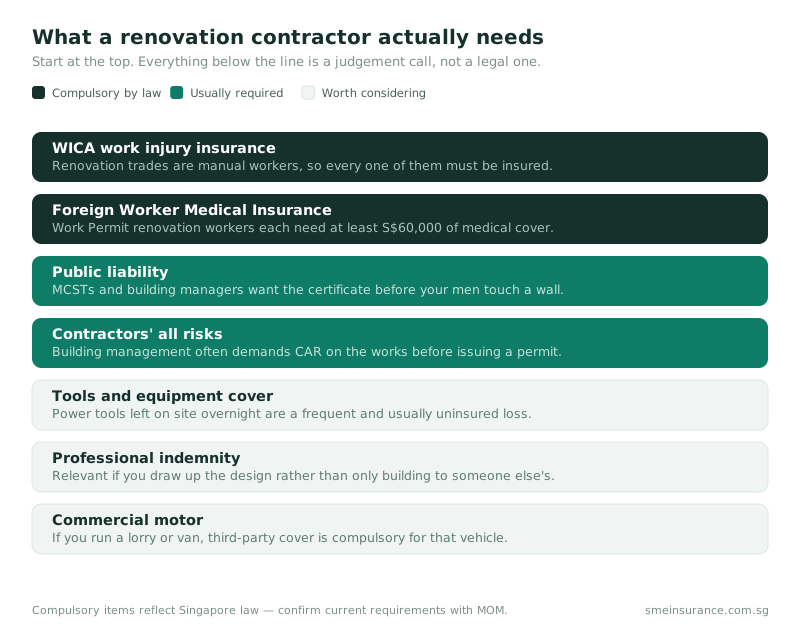
At a glance: what you need, and why
| Cover | Status | Why it matters here |
|---|---|---|
| WICA work injury insurance | Compulsory | Renovation trades are manual workers, so every one of them must be insured. |
| Foreign Worker Medical Insurance | Compulsory | Work Permit renovation workers each need at least S$60,000 of medical cover. |
| Public liability | Usually required | MCSTs and building managers want the certificate before your men touch a wall. |
| Contractors' all risks | Usually required | Building management often demands CAR on the works before issuing a permit. |
| Tools and equipment cover | Worth considering | Power tools left on site overnight are a frequent and usually uninsured loss. |
| Professional indemnity | Worth considering | Relevant if you draw up the design rather than only building to someone else's. |
| Commercial motor | Worth considering | If you run a lorry or van, third-party cover is compulsory for that vehicle. |
What must be in place by law
WICA work injury insurance is the compulsory foundation. Renovation workers — carpenters, tilers, electricians, painters, demolition crews — all do manual work, so under WICA you must insure every one of them regardless of salary, plus any non-manual staff earning S$2,600 a month or less. Going without is an offence carrying a fine of up to S$10,000, up to 12 months' jail, or both, and an uninsured injury claim lands on the company in full. Renovation trades are rated above office work, so expect premiums per worker in the hundreds rather than tens of dollars, quoted on actual trades. See our WICA guide.
If your crew includes Work Permit or S Pass holders — as most do — each needs Foreign Worker Medical Insurance with at least a S$60,000 annual claim limit, a separate obligation from WICA. Any company vehicle needs compulsory third-party motor cover. Confirm current workforce requirements with MOM.
What MCSTs, malls and main contractors demand before work starts
This is where renovation differs from most trades — the requirements come from whoever controls the site:
- MCSTs and condo managements typically require contractors to hold public liability insurance (limits of S$1 million are common, sometimes more) and often ask for the MCST to be named as an interested party, plus evidence of workmen's/WICA cover, before issuing a renovation permit. Some also require a deposit against damage to common property. Requirements vary by development — get the renovation guidelines early.
- Mall and building fit-out manuals for commercial units set out required covers and limits, usually public liability plus insurance of the fit-out works, verified before hoarding goes up.
- Main contractors engaging you as a subcontractor will require your WICA certificate and liability cover, and may require you to be covered under (or aligned with) the project's contractors' all risks policy. For HDB and other regulated works, use of appropriately registered contractors applies — insurance sits alongside, not instead of, those rules.
Keep scanned certificates of currency ready to send — speed of paperwork is a genuine competitive edge in this trade.
CAR per project, and the covers that protect your own kit
- Contractors' all risks (CAR). For renovation works of any substance, CAR covers damage to the works themselves (Section 1) and third-party liability arising from the works (Section 2) — a burst pipe flooding the unit below, a grinder fire, damage to the client's property. Small reno firms usually buy CAR per project, sized to the contract value; firms with steady pipelines can consider annual arrangements. See contractors' all risks and our renovation insurance requirements guide.
- Public liability standalone or via CAR Section 2 — check which structure each job's requirements accept, and whether the limit meets the MCST's or mall's stated minimum. More in the public liability guide.
- Tools and equipment cover. Power tools, ladders and small plant travel between sites in vans and vanish with depressing regularity. Standard property policies tied to one premises don't help; you need tools/equipment cover that follows the kit, including theft from vehicles (often with conditions about overnight storage).
- Damage to the client's existing property — distinct from the works themselves — is a wording point worth checking on every CAR policy, since in renovation the client's existing home or premises surrounds everything you do.
What it roughly costs
Indicative only — renovation premiums track trade risk and contract values:
- WICA: several hundred dollars per site worker per year for renovation trades; office staff from around S$50–100.
- Public liability: from around S$100–400 a year per S$1 million of cover for the annual policy, though hot works and demolition-heavy scopes rate higher.
- CAR: quoted per project as a function of contract value and scope — a S$30,000 HDB reno costs a fraction of a full commercial reinstatement to insure. No flat figure is honest; price it per job and build it into your quote.
- Tools cover: depends on declared values; modest for typical kits.
Actual premiums depend on your trades, project mix and claims record — get quotes, and get project CAR quotes before you commit to a contract price.
Frequently asked questions
What insurance does a renovation contractor need in Singapore?
By law: WICA insurance for all site workers regardless of salary (plus non-manual staff earning ≤S$2,600/month) and FWMI for any Work Permit or S Pass holders. By contract: public liability and usually contractors' all risks, at limits set by the MCST, building management or main contractor controlling the site. Tools and vehicle cover round out a typical programme.
Do condos require contractors to have insurance before renovation?
Almost always — MCSTs and managing agents typically require proof of public liability insurance (commonly S$1 million or more) and workmen's compensation cover before issuing a renovation permit, and often ask to be named as an interested party on the liability policy. Exact requirements vary by development, so request the renovation guidelines before you quote.
Do I buy contractors' all risks per project or annually?
Most small renovation firms buy CAR per project, sized to each contract's value and duration — it matches cost to revenue and satisfies per-job requirements. Firms running many concurrent projects can consider annual open-cover arrangements that pick up projects within agreed parameters. A licensed professional can tell you where the crossover point sits for your pipeline.
If my worker damages the client's home, which policy pays?
Damage to the client's property caused by your works is typically a liability claim under your public liability cover or the CAR policy's liability section — for example a flood from a pipe you cut, or a slab cracked during demolition. Damage to the renovation works themselves falls under CAR Section 1. Check both wordings cover the client's existing property, not just third parties off-site; this boundary is where renovation claims get argued.
Are my subcontractors covered by my insurance?
Their workers aren't — each subcontractor carries its own WICA obligation for its employees, and you should sight their certificates before they start. Your CAR policy can often be extended to cover subcontracted works on the project, but that's about the works, not their workforce. Put the split in writing in your subcontract terms.
Related cover & guides
Contractors' All Risks (CAR) Insurance
Covers construction and renovation works, materials and third-party damage. Routinely required by landlords, MCSTs and main contractors.
Read more →Work Injury Compensation (WICA) Insurance
Compulsory cover for workplace injuries. Required for all manual workers and non-manual staff earning ≤S$2,600/month.
Read more →Public Liability Insurance
Covers third-party injury and property damage. Not legally compulsory, but contractually required almost everywhere.
Read more →Insurance Requirements for Renovation Works in Singapore
What MCSTs and landlords demand before works start — CAR, public liability, workmen's compensation — and who buys: owner or contractor.
Read more →