
A car workshop combines three risks that rarely sit together: a yard full of other people's expensive property, a workforce doing heavy manual work with lifting equipment and power tools, and a building holding flammable liquids. Each is manageable. The problem is that the first one falls straight through the middle of a standard insurance programme.
General liability and property policies are built on a simple division — your property, and other people's. Property belonging to others that is in your care, custody or control is typically excluded from both: it is not yours, so your property policy will not pay for it, and it is in your control, so the standard liability policy excludes it too. A customer's car sitting in your workshop is the textbook example.
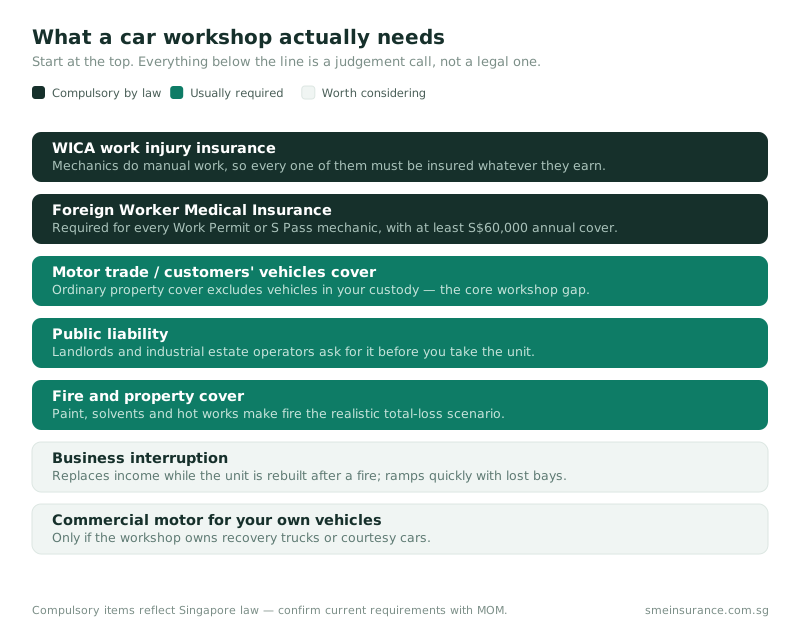
At a glance: what you need, and why
| Cover | Status | Why it matters here |
|---|---|---|
| WICA work injury insurance | Compulsory | Mechanics do manual work, so every one of them must be insured whatever they earn. |
| Foreign Worker Medical Insurance | Compulsory | Required for every Work Permit or S Pass mechanic, with at least S$60,000 annual cover. |
| Motor trade / customers' vehicles cover | Usually required | Ordinary property cover excludes vehicles in your custody — the core workshop gap. |
| Public liability | Usually required | Landlords and industrial estate operators ask for it before you take the unit. |
| Fire and property cover | Usually required | Paint, solvents and hot works make fire the realistic total-loss scenario. |
| Business interruption | Worth considering | Replaces income while the unit is rebuilt after a fire; ramps quickly with lost bays. |
| Commercial motor for your own vehicles | Worth considering | Only if the workshop owns recovery trucks or courtesy cars. |
Customers' vehicles: the gap that catches most workshops
Run through the ways a customer's car can be damaged while you have it, and check which policy answers for each:
- Damaged while it is parked in your yard or on the ramp — by fire, by a falling object, by another car being manoeuvred, by theft. Your property policy covers your property, not theirs. This is what a custody-and-control extension or a motor trade wording addresses.
- Damaged while being driven on the road — a road test, moving a car to a spray shop, collecting or returning a vehicle. Motor insurance providing at least third-party liability is compulsory for any vehicle used on a Singapore road under the Motor Vehicles (Third-Party Risks and Compensation) Act, and the customer's own policy will not necessarily extend to your staff driving it. Motor trade road risk cover is the standard answer, and it needs to name the categories of staff permitted to drive.
- Damaged by the work itself — an engine damaged during a rebuild, a panel scratched during a repair. This is faulty workmanship, which liability policies commonly exclude in whole or in part. Ask directly how the wording treats damage to the part you were working on versus damage to the rest of the vehicle; the two are often treated differently.
- Stolen from your premises — including theft of keys and the vehicle taken with them, which some wordings treat separately from forced-entry theft.
This is the single most important conversation to have at quotation stage. Describe your actual operation — how many vehicles you hold overnight, the maximum value of any one vehicle, whether the yard is secured and covered, whether you handle high-value or performance cars — and ask what limit applies per vehicle and in total. A limit set for a family hatchback will not respond usefully to a continental car in for engine work.
What the law requires
- Work injury compensation (WICA) insurance. Mechanics, technicians, spray painters, tyre fitters and workshop assistants all do manual work, so under WICA they must be insured regardless of salary. Your service advisor or admin staff must be insured if they earn S$2,600 a month or less. Operating without cover where it is required is an offence carrying a fine of up to S$10,000, up to 12 months' jail, or both. For accidents from 1 November 2025 the WICA limits run from S$91,000 to S$269,000 for death, S$116,000 to S$346,000 for total permanent incapacity, and medical expenses up to S$53,000 or one year, whichever comes first — see our WICA guide.
- Foreign Worker Medical Insurance (FWMI). Workshops commonly employ Work Permit and S Pass holders, and each one must have medical insurance with at least a S$60,000 annual claim limit — the enhanced requirement fully in effect since 1 July 2025. FWMI is separate from and additional to WICA. Confirm current requirements with MOM.
- Compulsory motor insurance. Any vehicle used on a Singapore road must carry at least third-party liability cover under the Motor Vehicles (Third-Party Risks and Compensation) Act. That applies to your own recovery truck, service vehicle or courtesy car — see commercial motor and fleet insurance — and it is the reason road risk cover for customers' vehicles is not an optional refinement.
Trade licensing and workshop-specific requirements, including anything relating to premises, waste and emissions, sit with the relevant authorities and are separate from insurance. Confirm current requirements with them rather than assuming a policy discharges them.
Fire, premises and the equipment you work with
Workshops hold paint, thinners, degreasers, brake cleaner, waste oil and solvent-soaked rags, and use grinders, welding sets and oxy-acetylene. That combination puts you in a higher fire bracket than a comparable industrial unit doing dry assembly, and underwriters price accordingly and ask questions before they do.
Expect to be asked about spray booth ventilation and filter maintenance, how flammables are stored, how waste rags and oil are disposed of, hot works controls, and your extinguisher and alarm arrangements. These are usually conditions of the policy rather than casual enquiries, and a breach is a route to a declined claim — the good news is that the same controls are the ones that stop the fire happening.
Commercial property cover should be set to reflect what it would cost to replace, not what your accounts say things are worth:
- Fixed equipment: two-post and four-post lifts, alignment rigs, tyre changers and balancers, compressors, the spray booth itself.
- Diagnostic and electronic equipment, which is often sub-limited under general contents wordings and worth listing separately.
- Hand tools. Mechanics frequently own their own sets, and a policy insuring only company property leaves an awkward gap after a theft or fire — clarify whose tools are covered.
- Parts stock, which can be a substantial and fluctuating sum.
- Business interruption, since a workshop out of action loses income while rent, mechanics' wages and lease payments on equipment continue.
Liability to customers, visitors and the public
Public liability insurance covers your legal liability for injury to third parties and damage to their property — a customer who slips on spilled oil in the reception area, a visitor struck by a moving vehicle in the yard, damage you cause to the neighbouring unit. If you rent an industrial unit, your landlord will very likely require it in the tenancy, commonly at S$1 million or more.
Two extensions specific to this trade are worth raising:
- Products liability for the parts you supply and fit. If a component you installed fails and causes an accident, the injured party will name the workshop that fitted it as readily as the manufacturer.
- Faulty workmanship, which is where most workshop disputes actually live. Standard liability wordings exclude the cost of redoing your own defective work, and treat resulting damage differently again. Understand the boundary before you rely on it.
If you run a fleet of your own vehicles — recovery trucks, mobile servicing vans, courtesy cars — those need their own commercial motor cover, and it is usually cheaper and simpler to place them together than one at a time. Our commercial vehicle guide covers how fleet rating works.
What it roughly costs
Indicative annual ranges. Workshop premiums are driven by what you hold and what you do to it, so treat these as a starting point rather than a quote:
- WICA: automotive repair is manual, higher-risk work, quoted as a rate on your annual wage roll rather than a flat sum per head — expect pricing well above office-level rates.
- Public liability: from around S$100–400 a year per S$1 million of cover, toward the upper end for premises open to the public with vehicles moving through them.
- Property, contents and equipment: from around S$200–500 a year at modest sums insured, materially more where there is a spray booth, high-value equipment or a substantial parts stock.
- Own commercial vehicles: roughly S$1,000–2,500 per vehicle per year for a recovery truck, van or courtesy car.
- Custody and control or motor trade cover for customers' vehicles: priced individually on the number and value of vehicles you hold, your security and your claims history. There is no meaningful published range — get it quoted as a distinct line item and check the per-vehicle and aggregate limits.
Actual premiums depend on your business — get a quote.
Frequently asked questions
Does my insurance cover a customer's car if it's damaged in my workshop?
Only if you have specifically arranged custody-and-control or motor trade cover for it — a standard property policy covers your own property, and a standard public liability policy typically excludes third-party property in your care, custody or control. That combination is the most common gap in workshop insurance programmes, so ask about it by name and check both the per-vehicle limit and the total limit for vehicles on site.
Do I need insurance to test-drive a customer's car?
Yes — any vehicle used on a Singapore road must carry at least third-party liability insurance under the Motor Vehicles (Third-Party Risks and Compensation) Act, and the customer's own policy will not necessarily extend to your staff driving it. Motor trade road risk cover is the usual solution, and it needs to specify which categories of your staff are permitted to drive.
Do mechanics need WICA insurance?
Yes — mechanics, technicians, spray painters and tyre fitters are manual workers, and WICA insurance is compulsory for employees doing manual work regardless of what they earn. Non-manual staff such as a service advisor must be insured if they earn S$2,600 a month or less. Failing to insure where the law requires it carries a fine of up to S$10,000, up to 12 months' jail, or both.
Will insurers cover a workshop that does spray painting?
Generally yes, but expect closer underwriting and a higher fire rate, because paint, thinners and solvent-soaked waste raise the fire hazard significantly. Insurers commonly ask about spray booth ventilation and filter maintenance, flammable storage, hot works controls, waste disposal and fire protection — and impose them as policy conditions, so make sure the answers you give are the practices you actually follow.
Am I covered if a repair I did causes an accident later?
Possibly — public and products liability can respond to injury or third-party damage arising from a part you supplied or work you performed, but the cost of redoing your own defective workmanship is commonly excluded. Wordings differ meaningfully on where they draw the line between the defective work itself and the damage it causes, so ask for that boundary to be explained before you need it.
Are my mechanics' own tools covered if the workshop is broken into?
Not automatically — many contents policies insure only property belonging to the business, which leaves personally owned tool sets outside cover. Since mechanics in this trade frequently own their tools, raise it at quotation stage and have employees' tools specifically included or separately insured, with a realistic sum for what a full set costs to replace.
Related cover & guides
Commercial Motor & Fleet Insurance
Compulsory third-party cover for every vehicle under Singapore law, plus comprehensive and fleet options for business use.
Read more →Public Liability Insurance
Covers third-party injury and property damage. Not legally compulsory, but contractually required almost everywhere.
Read more →Work Injury Compensation (WICA) Insurance
Compulsory cover for workplace injuries. Required for all manual workers and non-manual staff earning ≤S$2,600/month.
Read more →Commercial Vehicle Insurance in Singapore: A Guide
The compulsory third-party minimum, comprehensive vs TPFT vs TPO, goods and courier use, named vs any-driver, and fleets.
Read more →