
The work splits cleanly in two. Before the hacking starts you are a professional: you measure, specify, draw, advise on materials and finishes, and tell a client what will fit and what will work. Once works begin you are running a site where things get broken — a drilled water pipe, a scratched marble lobby floor, a neighbour's ceiling stained by your wet works. The first is professional risk, the second is physical risk, and a policy written for one does not respond to the other.
The picture gets more tangled because most ID firms sit between a client and a chain of subcontractors, so the practical question at every incident is not just what is covered but whose policy answers. Getting that settled in the contract, before the first day of works, costs nothing. Getting it settled after a flood costs a project.
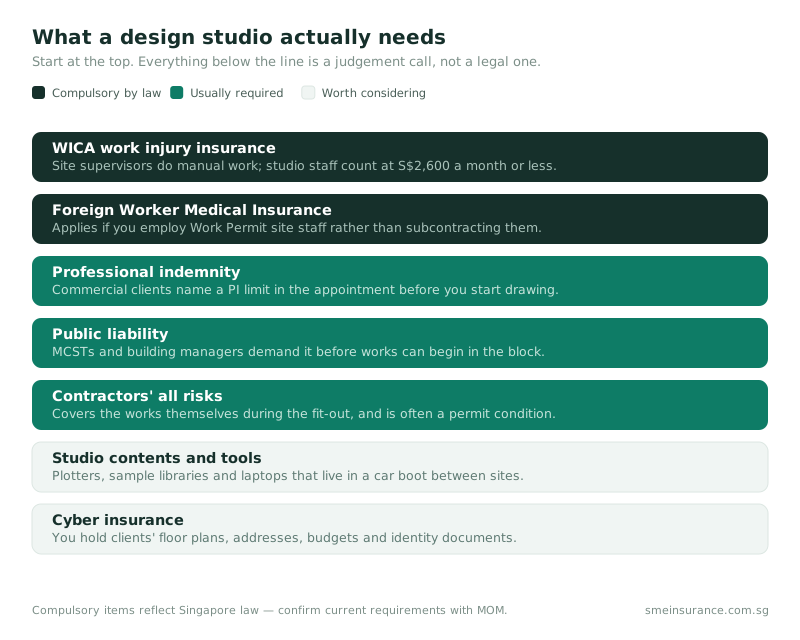
At a glance: what you need, and why
| Cover | Status | Why it matters here |
|---|---|---|
| WICA work injury insurance | Compulsory | Site supervisors do manual work; studio staff count at S$2,600 a month or less. |
| Foreign Worker Medical Insurance | Compulsory | Applies if you employ Work Permit site staff rather than subcontracting them. |
| Professional indemnity | Usually required | Commercial clients name a PI limit in the appointment before you start drawing. |
| Public liability | Usually required | MCSTs and building managers demand it before works can begin in the block. |
| Contractors' all risks | Usually required | Covers the works themselves during the fit-out, and is often a permit condition. |
| Studio contents and tools | Worth considering | Plotters, sample libraries and laptops that live in a car boot between sites. |
| Cyber insurance | Worth considering | You hold clients' floor plans, addresses, budgets and identity documents. |
Two policies for two different kinds of mistake
This is the distinction worth ten minutes of your time, because getting it wrong is expensive in exactly the situations you cannot afford:
| What went wrong | Which policy responds |
|---|---|
| You specified a finish unsuitable for a wet area and it has to be ripped out and redone | Professional indemnity |
| Your drawings misread the site and the carpentry does not fit | Professional indemnity |
| You advised a layout that breached a building or fire requirement, and the works must be altered | Professional indemnity |
| A worker drills through a concealed pipe and floods the unit below | Public liability |
| A delivery scratches the condominium's lobby floor | Public liability |
| A client's visitor trips over site materials and is injured | Public liability |
| Materials already installed are damaged by fire or water before handover | Contractors' all risks |
Professional indemnity covers your legal liability for financial loss caused by negligent advice, design or specification, and — just as importantly — the cost of defending the allegation. It is written on a claims-made basis, meaning the policy in force when the claim is made responds, not the one in force when you drew the plan. That has a practical consequence: if you let cover lapse after a project completes, a claim arriving a year later has nothing to attach to.
Public liability covers injury to third parties and damage to their property. Note what it typically excludes: property in your care, custody or control — which can include the very unit you are working in. If your public liability policy does not carry an appropriate care-custody-and-control extension, damage to the client's own premises may sit outside cover even though damage to the neighbour's is inside it. Our PI vs PL guide works through more examples.
The build phase: contractors' all risks and who buys it
Contractors' all risks (CAR) insures the works themselves during construction — the partitions, carpentry, wiring and finishes you have installed but not yet handed over — plus materials on site, and it usually bundles a third-party liability section for the works. If a fire, burst pipe or theft hits a job at eighty per cent complete, CAR is the cover that pays to rebuild it. Without it, the party carrying the risk under the contract simply eats the cost.
Who buys it depends on how you are structured, and this is the part firms should decide deliberately rather than by default:
- You contract with the client and subcontract the build. You are the main contractor in substance whatever your job title says, so the works risk is yours until handover. Either arrange CAR yourself, or require it contractually from your appointed contractor with you named as a joint insured — not merely "noted".
- You design only and the client appoints the contractor directly. The contractor should carry CAR and their own workmen's compensation and public liability. Your job is to see the certificates before works start and to keep the design and build responsibilities clearly separated in your appointment letter.
- Renovation works to an existing property. CAR arranged for renovation typically covers the new works; damage to the existing structure is handled by an extension for existing surrounding property, which is exactly the extension that pays when your works damage the client's original flooring or the unit next door. Check that it is present and that the limit is sensible.
Being a joint insured matters more than most people realise: a party named as joint insured has rights under the policy, whereas a party merely noted as interested may have none. Ask for the certificate and check the wording, not just the covering email.
What the MCST, landlord or building management will demand
Before renovation works begin, an MCST or building management office will typically require the contractor and often the designer to produce a package of documents. Requirements are set by each MCST or landlord rather than by one national rule, so read the specific house rules — but the recurring items are:
- Public liability insurance at a specified limit, frequently S$1 million or more, sometimes with the MCST or landlord named as an interested party.
- Work injury compensation insurance for everyone who will be on site. Renovation trades are manual workers, so under WICA they must be insured regardless of salary.
- Contractors' all risks for the works, particularly in commercial buildings and for anything structural or wet.
- A renovation deposit held against damage to common property, plus permitted working hours, lift protection and debris removal arrangements.
- Approvals for any works affecting structure, fire safety or common property — these run through the relevant authorities and the MCST, and they are separate from insurance. Confirm current requirements with the building management and the relevant authority before you commit to a start date.
Practical advice: collect these certificates from your subcontractors at appointment, not on the morning the MCST asks. A project that cannot start because a contractor's WICA certificate has expired is a delay your client will remember. Our renovation insurance requirements guide covers the paperwork in more detail.
Your own firm: staff, studio and data
- WICA for your own people. Site supervisors and project coordinators spending their days on site are doing work with a manual element, and WICA insurance is compulsory for manual workers regardless of salary and for non-manual employees earning S$2,600 a month or less. Non-compliance is an offence carrying a fine of up to S$10,000, up to 12 months' jail, or both. See our WICA guide.
- Studio contents and equipment. Workstations, plotters, sample libraries and the fit-out of your own showroom. Add cover for tools, laptops and measuring equipment away from the premises, since most of it lives in a car boot.
- Cyber. You hold clients' floor plans, addresses, renovation budgets and identity documents, and you move money on their behalf. Payment-diversion fraud — a fake email redirecting a progress payment — is a live risk in this trade, and a cyber policy is where that exposure and the PDPA response costs are addressed.
- Contract works retention and defects liability. Understand how long you remain responsible for defects after handover under your standard client contract; that period is when PI claims tend to arrive.
What it roughly costs
Indicative annual ranges for a small ID firm. Fee income, project values and the type of work — residential fit-out versus commercial or structural — move these considerably:
- Professional indemnity: from around S$300–800 a year for a small firm at modest limits, rising with fee income and with the limit your commercial clients demand.
- Public liability: from around S$100–400 a year per S$1 million of cover, higher where works involve wet areas, hacking or occupied commercial premises.
- Contractors' all risks: quoted per project on the contract value, or as an annual open cover if you run a steady flow of jobs. Rates depend on the works, not on your headcount.
- WICA: from around S$100–300 per site-based employee per year; studio staff considerably less.
- Office contents: from around S$200–500 a year.
A two-person design studio without site responsibility can be insured for a fraction of what a design-and-build firm carrying the works risk will pay — the difference is not the number of staff, it is who carries the build. Actual premiums depend on your business — get a quote.
Frequently asked questions
Do interior designers need professional indemnity insurance in Singapore?
No national law makes it compulsory for interior designers, but it is the core cover for the risk you actually run — a claim that your design, specification or advice caused a client financial loss. Commercial clients, developers and government-linked projects frequently require it as a condition of appointment at a stated limit, so in practice you will often need it to win the work.
What's the difference between professional indemnity and public liability for a design firm?
Professional indemnity responds to financial loss caused by your advice, drawings or specification; public liability responds to physical injury to people and damage to property. Specifying the wrong waterproofing membrane is a PI claim. A worker drilling through a pipe and flooding the unit below is a PL claim. Neither policy will answer for the other, which is why design-and-build firms need both.
Who should buy the contractors' all risks policy — me or my contractor?
Whoever carries the works risk under the contract, which is usually the party that contracted with the client to deliver the build. If you take the project on and subcontract the works, that is you in substance regardless of your job title — so either arrange CAR yourself or require your contractor to carry it with you named as a joint insured, and check the certificate before works start.
The condo management wants insurance before renovation starts. What do they usually ask for?
Most commonly public liability insurance at a stated limit (often S$1 million or more, sometimes naming the MCST), work injury compensation insurance for everyone on site, and for larger jobs a contractors' all risks policy — alongside a renovation deposit, approved working hours and lift protection. Requirements are set by each MCST or landlord rather than by a single national rule, so ask for the house rules in writing before you commit to a start date.
Am I liable if my subcontractor damages a client's unit?
Usually yes in the first instance, because your contract is with the client and they will pursue you rather than a subcontractor they never engaged. Whether you can pass that cost down depends on your subcontract terms and on whether the subcontractor actually holds live insurance — which is why collecting certificates at appointment, and checking that damage to the client's existing property is covered rather than excluded as property in your care, is worth the administrative effort.
Does my insurance still respond after the project is handed over?
For professional indemnity, only if the policy is still in force when the claim is made — PI is written on a claims-made basis, so a claim about a project you finished two years ago attaches to today's policy, not the one you held at the time. That is the reason firms maintain cover continuously, and consider run-off cover if they stop trading. Contractors' all risks, by contrast, generally ends at handover or at the end of any defects liability period stated in the policy.
Related cover & guides
Professional Indemnity Insurance
Covers negligence, errors and omissions in professional work. Required by some professional bodies and many B2B contracts.
Read more →Contractors' All Risks (CAR) Insurance
Covers construction and renovation works, materials and third-party damage. Routinely required by landlords, MCSTs and main contractors.
Read more →Public Liability vs Professional Indemnity: The Difference
PL covers injury and property damage you cause; PI covers financial loss from your advice. Scenario table shows which pays when.
Read more →Insurance Requirements for Renovation Works in Singapore
What MCSTs and landlords demand before works start — CAR, public liability, workmen's compensation — and who buys: owner or contractor.
Read more →